I use AI every working day now, and the hardest part for most people I talk to is not the tools. It is the story: why a chat window turned up out of nowhere in 2022, and why, three years later, everyone started saying "agent." This lesson is that story in seven short stops, from a 1950 paper to the agents of 2026. No math and no code. Each date links to its source.
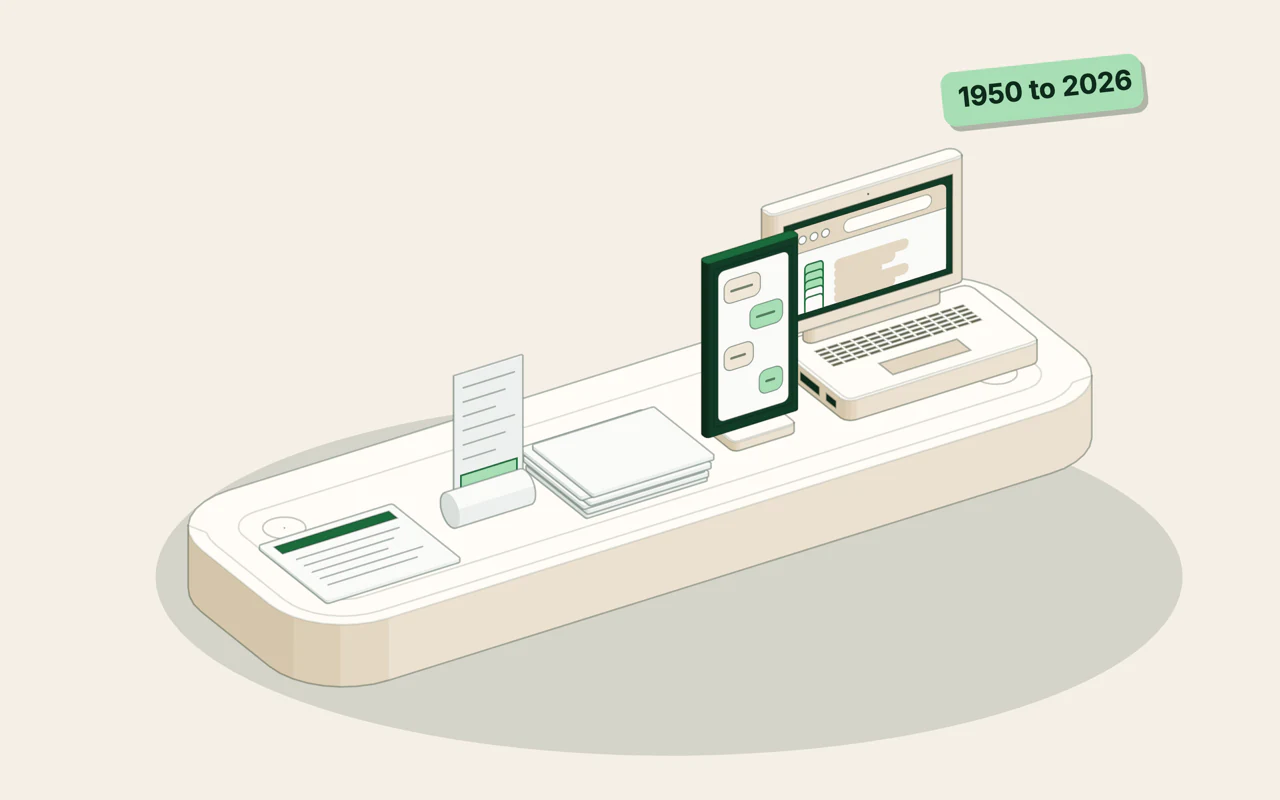
The whole story on one line
1950 and 1956: a question and a name
In 1950 the mathematician Alan Turing published "Computing Machinery and Intelligence," which opens with the question "Can machines think?" Rather than argue about the word "think," he proposed a test he called the imitation game: if a person typing to a hidden partner cannot tell whether it is a person or a machine, the machine has done something worth taking seriously. Six years later, in the summer of 1956, a workshop at Dartmouth College gave the new field its name: artificial intelligence.
1966: ELIZA, a chatbot made of rules
Joseph Weizenbaum at MIT described ELIZA in 1966. It looked for patterns in what you typed and handed your words back as a question. Its best-known script played a therapist: type "I feel tired" and it might answer "Why do you feel tired?"
Think of a phrasebook. ELIZA never understood a sentence; it found a matching rule and filled in the blanks. People still felt heard, and some confided in it. That is the first lesson of this whole history, and it still holds: a fluent reply is not the same as an understanding one, or a correct one.
1980s to 2010s: learning from examples
Hand-written rules hit a wall. Nobody can write enough of them to cover real language, or to recognize a face. Machine learning flipped the approach: show the system thousands of examples and let it find the patterns itself. It is how a child learns what a dog is, by seeing a lot of dogs, not by memorizing a definition. Around 2012 a version called deep learning, which stacks many layers of pattern-finding, started beating every older method at recognizing images, and the field changed course.
2017: the transformer
In June 2017 a team of Google researchers published "Attention Is All You Need." It described the transformer, a design that reads a whole passage at once and works out which words matter to which. In "the client cancelled because she was sick," it learns that "she" points back to "the client." Every major chat model today is built on this design. The T in GPT stands for transformer.
2020 to 2022: one big model, then a chat window
A large language model is a transformer trained on an enormous amount of text to do one thing: predict the next piece of a sentence. Picture your phone's autocomplete after it has read a library. Doing that one thing well turns out to let it summarize, draft, translate and answer questions.
In May 2020 OpenAI's GPT-3 paper showed that one very large model could take on many different tasks from a written request and a few examples, with no retraining. Then on November 30, 2022, OpenAI released ChatGPT, describing it as a model "which interacts in a conversational way." That was the moment it reached ordinary people: no setup, just a box to type in. Other companies followed with their own chat apps; X's Grok, for example, reached all US Premium+ subscribers in December 2023.
In a chat, you ask and it answers. Whatever happens next (copying the answer, checking it, acting on it) is still your job.
2024 to 2026: from chatting to delegating
The last two years changed what these models are for. Instead of answering once, a model can now be set up to work in a loop: make a plan, use a tool, look at the result, and keep going until the job is done or it needs you. That loop is what people mean by an agent. A calculator does what you press; a contractor takes the job and comes back when it is finished, or when there is a question only you can answer.
- November 2024. Anthropic released the Model Context Protocol (MCP), an open standard for connecting AI apps to data and tools. Think of a standard wall outlet: any appliance that fits it gets power.
- December 2024. Anthropic's "Building effective agents" drew the line I still use. Workflows follow "predefined code paths." Agents are "systems where LLMs dynamically direct their own processes and tool usage."
- February and May 2025. Anthropic opened Claude Code as a research preview, a way to hand "substantial engineering tasks" to Claude from a computer's terminal, then made it generally available in May.
- April 2026. Cursor 3.0 added a window for running many agents side by side, and Meta launched Muse Spark, the model behind its free Meta AI app.
- August and September 2026. Grok Bot opened an early beta: agents that keep working on their own cloud computer. Meta launched Muse, a personal agent app that can send email and fill in forms for you.
So in under four years, the everyday question went from "what can I ask it?" to "what can I hand it?" The next lesson sorts out the five words this new world runs on.
What has not changed since ELIZA
- Fluent is not the same as right. Today's models are far more capable than a phrasebook, and they still state wrong things with confidence. Check anything that matters: a date, a law, a number, a dose.
- It does not know you. It knows what you typed and what the app lets it see. Better input gets better output.
- Client information stays out. A consumer chat app is not a place for anything a client told you. The rules, and the few setups that can be different, are in HIPAA-safe AI tools, BAAs, and what not to paste.
I checked each date here against the linked sources in November 2026. The oldest stops on this line will not move. The 2026 names will, probably within months, but the shape of the story (rules, then learning, then chatting, then delegating) is the part worth keeping.
Further reading
- Building effective agents, Anthropic. The clearest plain explanation of workflows versus agents, and when to use neither.
- Introducing ChatGPT, OpenAI. The November 2022 announcement, short and readable.
- Large Language Models explained briefly, 3Blue1Brown. Eight minutes, with pictures instead of math.
This lesson's video has its own page
Sources
- “Computing Machinery and Intelligence.” Mind (Oxford University Press). Opens with "Can machines think?" and proposes the imitation game. https://doi.org/10.1093/mind/LIX.236.433 (accessed Nov 24, 2026).
- “ELIZA: a computer program for the study of natural language communication between man and machine.” Communications of the ACM. Pattern-matching chatbot; its best-known script played a therapist. https://doi.org/10.1145/365153.365168 (accessed Nov 24, 2026).
- “Attention Is All You Need.” arXiv, Jun 12, 2017. The transformer architecture current large language models are built on. https://arxiv.org/abs/1706.03762 (accessed Nov 24, 2026).
- “Language Models are Few-Shot Learners (GPT-3).” arXiv, May 28, 2020. One large model handles many tasks from a prompt and a few examples. https://arxiv.org/abs/2005.14165 (accessed Nov 24, 2026).
- “Introducing ChatGPT.” OpenAI, Nov 30, 2022. "We've trained a model called ChatGPT which interacts in a conversational way.". https://openai.com/index/chatgpt/ (accessed Nov 24, 2026).
- “X's AI chatbot Grok now rolled out to all US Premium+ subscribers.” TechCrunch, Dec 8, 2023. https://techcrunch.com/2023/12/08/xs-ai-chatbot-grok-now-rolled-out-to-all-u-s-premium-subscribers-english-language-users-are-next (accessed Nov 24, 2026).
- “Introducing the Model Context Protocol.” Anthropic, Nov 25, 2024. Open standard for connecting AI apps to data and tools. https://www.anthropic.com/news/model-context-protocol (accessed Nov 24, 2026).
- “Building effective agents.” Anthropic, Dec 19, 2024. Workflows follow predefined code paths; agents direct their own processes and tool use. https://www.anthropic.com/engineering/building-effective-agents (accessed Nov 24, 2026).
- “Claude 3.7 Sonnet and Claude Code.” Anthropic, Feb 24, 2025. Claude Code launched as a limited research preview. https://www.anthropic.com/news/claude-3-7-sonnet (accessed Nov 24, 2026).
- “Introducing Claude 4.” Anthropic, May 22, 2025. Claude Code generally available. https://www.anthropic.com/news/claude-4 (accessed Nov 24, 2026).
- “Cursor 3.0 changelog.” Cursor, Apr 2, 2026. Agents Window runs many agents in parallel. https://cursor.com/changelog/3-0 (accessed Nov 24, 2026).
- “Introducing Muse Spark.” Meta, Apr 8, 2026. First Muse model; powers the Meta AI app. https://about.fb.com/news/2026/04/introducing-muse-spark-meta-superintelligence-labs/ (accessed Nov 24, 2026).
- “SpaceXAI's Grok Bot turns agents into persistent digital coworkers.” VentureBeat, Aug 11, 2026. Grok Bot early beta. https://venturebeat.com/ai/spacexais-grok-bot-turns-agents-into-persistent-digital-coworkers-that-can-operate-your-apps-for-120-per-month/ (accessed Nov 24, 2026).
- “Meta debuts its Muse AI agent.” TechCrunch, Sep 8, 2026. Personal agent app. https://techcrunch.com/2026/09/08/meta-debuts-its-muse-ai-agent-will-consumers-trust-it/ (accessed Nov 24, 2026).
- “Large Language Models explained briefly.” 3Blue1Brown (YouTube), Nov 20, 2024. The video on this lesson. https://www.youtube.com/watch?v=LPZh9BOjkQs (accessed Nov 24, 2026).
Study guide
The arc in one sentence
Rules-based chatbots (1966) gave way to systems that learn from examples; the 2017 transformer made large language models possible; ChatGPT (2022) put one in everyone's hands; and 2024 to 2026 moved from chatting to delegating.
Dates to remember
- 1950: Turing asks "Can machines think?" (paper)
- 1956: a Dartmouth workshop names the field artificial intelligence
- 1966: ELIZA, a chatbot made of rules (paper)
- Around 2012: deep learning takes off
- 2017: the transformer (paper)
- 2020: GPT-3, one model for many tasks (paper)
- November 30, 2022: ChatGPT (OpenAI)
- November 2024: MCP (Anthropic)
- 2025: Claude Code, preview in February, generally available in May
- 2026: Cursor 3.0, Muse Spark, Grok Bot beta, the Muse agent app
Key terms
- Machine learning: finding patterns from examples instead of following written rules
- Transformer: the 2017 design that reads a passage at once and weighs which words relate
- Large language model: a transformer trained on huge amounts of text to predict the next piece
- Agent: a model working in a loop (plan, use a tool, check, repeat) toward a goal
- MCP: an open standard for plugging tools and data into AI apps
Habits that carry forward
- Check anything that matters: dates, laws, numbers
- Give it better input; it knows only what it can see
- Client information never goes into a consumer chat app (the HIPAA lesson)
Check what you learned
10 questions from this lesson. Answers are checked as you go; nothing is recorded.
1 / 10
What question opens Alan Turing's 1950 paper?
Hint
The 1950 section quotes it.
Turing opened with "Can machines think?" and proposed the imitation game as a practical test.
2 / 10
How did ELIZA (1966) produce its replies?
Hint
Think of a phrasebook.
ELIZA used hand-written rules: find a pattern, hand your words back as a question. It understood nothing.
3 / 10
What is the lasting lesson the lesson draws from ELIZA?
Hint
See the end of the ELIZA section.
People felt heard by a program that understood nothing. Modern models are far more capable, and fluency still does not prove correctness.
4 / 10
What changed when machine learning replaced hand-written rules?
Hint
How does a child learn what a dog is?
Instead of writing every rule, people showed the system thousands of examples and let it find the patterns.
5 / 10
What did the 2017 paper "Attention Is All You Need" introduce?
Hint
The T in GPT.
The transformer reads a whole passage at once and works out which words matter to which. Every major chat model today uses it.
6 / 10
In plain words, what is a large language model trained to do?
Hint
Autocomplete that read a library.
It predicts the next piece of a sentence. Doing that well lets it draft, summarize, translate and answer.
7 / 10
When did OpenAI release ChatGPT?
Hint
The chat window section.
ChatGPT came out on November 30, 2022, and put a large language model in front of ordinary people.
8 / 10
What is the main difference between a chat and an agent?
Hint
Calculator versus contractor.
In a chat you ask, it answers, and you do the rest. An agent takes a goal and works through the steps until it is done or needs you.
9 / 10
What is the Model Context Protocol (MCP), released by Anthropic in November 2024?
Hint
The wall outlet analogy.
MCP is a standard plug: tools and data built to it can connect to any AI app that supports it.
10 / 10
Which rule about client information does the lesson give?
Hint
The last section.
A consumer chat app is not a place for anything a client told you. The HIPAA-safe AI tools lesson covers the details.
Worth another look


