An AI scribe listens to a session, or to your dictation afterward, and drafts the progress note. Used well, it gives you back the minutes after each client and lets you look at the person in front of you instead of a keyboard. Used carelessly, it puts session audio on a server you never vetted and a note you never really read into a chart with your signature on it. This lesson walks through what to ask a vendor, how to get consent that holds up under Oregon's recording law, and a review routine for every draft. It assumes you have read HIPAA-safe AI tools, which covers business associate agreements for AI vendors.
What a scribe does with your session
Most tools work one of two ways. An ambient scribe captures the conversation while it happens; a dictation tool listens only to you, after the client has left. Either way, audio or a transcript leaves your device, a model turns it into text, and the vendor's systems hold some of it for some period. That makes the vendor a business associate: HHS's business associate guidance has long listed transcription vendors as an example, and an AI scribe is transcription with a summary on top. A signed BAA is the floor, not a bonus.
The American Psychological Association published a preliminary guide to evaluating AI scribes and, separately, a companion checklist for evaluating any AI tool (October 2024). The scribe guide covers data security, ambient listening versus dictation, and setting up an informed consent process and documentation policy before you start. APA's broader ethical guidance for AI in practice (updated July 2025) adds that psychologists "must ensure that any tools they select can be used in a manner that is in compliance with HIPAA." Both are written for psychologists and are not binding rules, but the questions apply to any license.
Questions to put to a vendor, in writing
- Will you sign a BAA, and for which plan? No BAA, no session audio.
- Where is audio processed and stored, and for how long? Ask whether audio is deleted once the note is drafted, or kept, and who can change that setting.
- Is my data used to train or improve your models? APA's checklist asks this directly. Get the answer in the contract, not only in a sales email.
- Who are your subprocessors? The model provider and the cloud host are usually other companies; your BAA should bind them through the vendor.
- Can I export my notes, and what happens to my data if I cancel?
- What accuracy testing have you published? APA's ethical guidance encourages tools that "have undergone rigorous accuracy testing" with results the developer has made public.
Consent, and Oregon's recording law
Oregon's eavesdropping statute, ORS 165.540, bars obtaining a conversation with a device "if not all participants in the conversation are specifically informed that their conversation is being obtained." The definitions in ORS 165.535 say a conversation includes one held through a video conferencing program. An ambient scribe in the room or on a video session is recording that conversation, so everyone in it, including a partner or a parent in a family session, needs to be specifically told. A violation of that subsection is a Class A misdemeanor.
The ethics codes ask for more than notice. For LPCs and LMFTs, the Oregon board adopts the 2014 ACA Code through OAR 833-100-0011, and the ACA Code at B.6.c says counselors "obtain permission from clients prior to recording sessions through electronic or other means." APA's guidance suggests naming the AI tool in your written informed consent and telling clients they can opt out, with alternatives explained. In practice that means a written consent that says which tool, what it captures, where the audio goes, how long it is kept, and how to say no, plus a spoken check at the start of each session it runs. A client who declines gets the same care, with you writing the note yourself.
You sign it, so it is your record
APA's ethical guidance is plain on this: "Psychologists remain responsible for final decisions and must not blindly rely on AI-generated recommendations." Your board sees it the same way. Under OAR 833-075-0070, LPCs and LMFTs keep client records, including progress notes, for at least seven years from the last date of service, and records "should be recorded concurrently with the services provided." A draft from software becomes your record the moment you sign it, errors included. The note format does not change either; the progress notes lesson covers SOAP, DAP, and BIRP.
When you review a draft, read it against your own memory of the hour, not for grammar. Look for things the client did not say, things they said that the draft dropped, statements credited to the wrong person, and clinical language or diagnoses you did not use. Cut detail the record does not need; a transcript-length note discloses more than the next reader requires.
How to bring a scribe into your practice
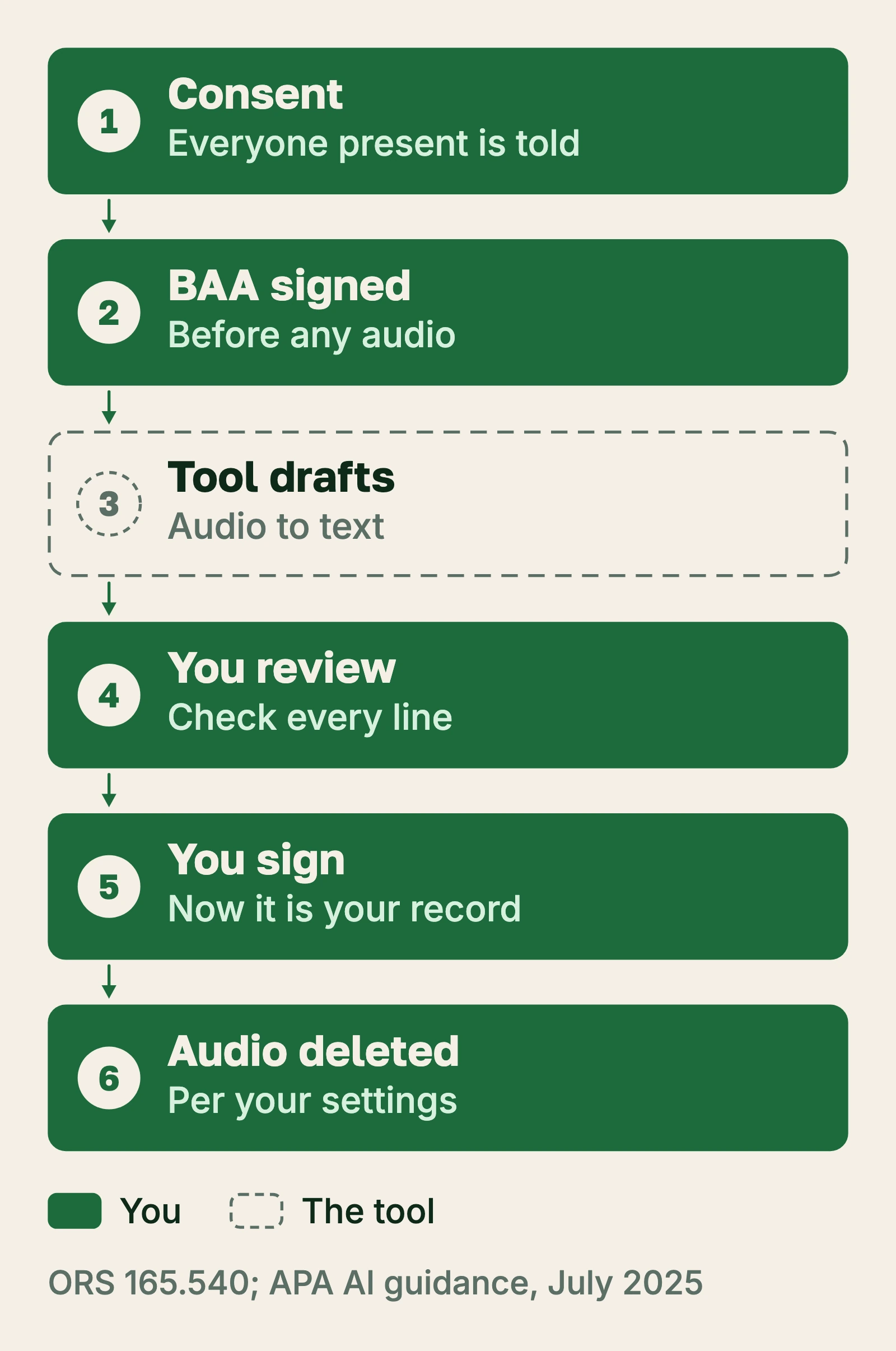
- Pick ambient or dictation. Dictation after the session captures only your voice and is the smaller privacy step; ambient captures everyone.
- Send the vendor the questions above and keep the written answers with your compliance file.
- Sign the BAA before the first session audio reaches the vendor, and confirm it covers your plan.
- Set retention and training options to the most protective settings you can work with: audio deleted after the draft, no training on your data.
- Add the tool to your risk analysis and your acceptable-use list.
- Update your informed consent to name the tool, what it records, where the data goes, how long it is kept, and how to opt out. Read the APA guidance section on transparency and consent as you write it.
- Ask at the start of every session it runs, and tell every person present, as ORS 165.540 requires. Note the consent in the record.
- Review, edit, and only then sign each draft, the same day if you can.
- Spot-check monthly. Pick a few signed notes and compare them with your memory of the session. If errors keep showing up, or the vendor has a security problem, stop using the tool; APA's guidance calls for "promptly discontinuing" an AI tool if misinformation concerns arise, and for dropping one when security concerns arise.
If you are an LCSW, a psychologist, or another licensee, your own board's rules and code govern consent and records; check them rather than assuming the counselor board's rules above carry over. None of this is legal advice. I quoted the statute, the rules, and the guidance and linked each one; an attorney or your board has the final word on how they apply to you.
Further reading
- APA: Guidance for the evaluation of AI scribes. The preliminary guide and companion checklist, with an informed consent section.
- APA: Ethical guidance for AI in the professional practice of health service psychology (PDF, updated July 2025). Consent, opt-out, HIPAA review, human oversight, and when to stop using a tool.
- Oregon Revised Statutes, chapter 165. ORS 165.535 and 165.540, the recording rules, in full.
- Oregon counselor board statutes and rules (PDF). OAR 833-075-0070 on client records and OAR 833-100-0011 adopting the ACA Code.
- AI for admin and marketing copy. The next lesson in this topic.
Sources
- “Guidance for the evaluation of AI scribes.” American Psychological Association. Preliminary guide; APA companion checklist for AI tools dated October 2024. Page did not render for automated fetch; confirmed by search. https://www.apa.org/topics/artificial-intelligence-machine-learning/evaluating-ai-scribes.html (accessed Nov 16, 2026).
- “Ethical Guidance for AI in the Professional Practice of Health Service Psychology.” American Psychological Association. Cover reads UPDATED: JULY 2025. Quotes on HIPAA compliance, accuracy testing, human responsibility, and promptly discontinuing a tool. https://www.apa.org/topics/artificial-intelligence-machine-learning/ethical-guidance-professional-practice.pdf (accessed Nov 16, 2026).
- “Business Associates.” U.S. Department of Health and Human Services, Office for Civil Rights. Transcription vendors listed as business associates. https://www.hhs.gov/hipaa/for-professionals/privacy/guidance/business-associates/index.html (accessed Nov 16, 2026).
- “ORS Chapter 165 (ORS 165.535 definitions; ORS 165.540 obtaining contents of communications).” Oregon State Legislature. 165.540(1)(c): all participants specifically informed; 165.535(1): conversation includes video conferencing; violation of (1) is a Class A misdemeanor. https://www.oregonlegislature.gov/bills_laws/ors/ors165.html (accessed Nov 16, 2026).
- “Oregon Board of Licensed Professional Counselors and Therapists: Statutes and Oregon Administrative Rules (Revised 2/26).” Oregon Board of Licensed Professional Counselors and Therapists. OAR 833-075-0070 client records (seven years; recorded concurrently); OAR 833-100-0011 adopts the 2014 ACA Code. https://www.oregon.gov/oblpct/Documents/BLPCT_Statutes-OARs.pdf (accessed Nov 16, 2026).
- “2014 ACA Code of Ethics.” American Counseling Association. B.6.c Permission to Record. https://www.counseling.org/docs/default-source/default-document-library/ethics/2014-aca-code-of-ethics.pdf (accessed Nov 16, 2026).
Study guide
What a scribe is
- Ambient: captures the whole conversation; dictation: captures only you, after the session
- Audio or text leaves your device, so the vendor is a business associate (HHS lists transcription vendors); a BAA is the floor
- APA preliminary scribe guide and checklist (October 2024); APA ethical guidance (updated July 2025): written for psychologists, not binding, useful for any license
Vendor questions, answered in writing
- BAA, and for which plan
- Where audio is processed and stored, and when it is deleted
- Whether your data trains or improves models
- Subprocessors bound through the BAA
- Export and cancellation terms
- Published accuracy testing
Consent and Oregon law
- ORS 165.540(1)(c): a conversation may not be obtained by device unless all participants are specifically informed; ORS 165.535 includes video conferencing; a violation is a Class A misdemeanor
- LPC and LMFT: ACA B.6.c, permission before recording (adopted by the Oregon board)
- Written consent names the tool, what it records, where data goes, how long it is kept, how to opt out; ask again each session it runs
- A client who declines gets the same care
The record is yours
- APA: clinicians "remain responsible for final decisions and must not blindly rely" on AI
- Oregon LPC and LMFT records: progress notes required, kept at least seven years from last service, recorded concurrently with services
- Review for: things not said, things dropped, wrong speaker, clinical language you did not use; trim excess detail
Steps
- Choose ambient or dictation
- Send vendor questions; file the answers
- Sign the BAA before any audio
- Most protective retention and training settings
- Add to risk analysis and acceptable-use list
- Update informed consent
- Ask each session; tell everyone present; note consent
- Review, edit, sign
- Spot-check monthly; stop if accuracy or security fails
Scope
- LCSWs, psychologists, and other licensees: check your own board's rules on consent and records
Official pages
Check what you learned
10 questions from this lesson. Answers are checked as you go; nothing is recorded.
1 / 10
Why is an AI scribe vendor a HIPAA business associate?
Hint
See "What a scribe does with your session."
HHS has long listed transcription vendors as business associates. A scribe receives and processes PHI for you, so a BAA is the floor.
2 / 10
Which difference between an ambient scribe and a dictation tool does the lesson stress?
Hint
Step 1 of the how-to.
Dictation after the session captures only you, a smaller privacy step. An ambient scribe captures every participant.
3 / 10
Under ORS 165.540(1)(c), who must be specifically informed before a device obtains an in-person conversation?
Hint
Quoted in "Consent, and Oregon's recording law."
The statute bars obtaining a conversation by device "if not all participants in the conversation are specifically informed."
4 / 10
Does Oregon's definition of "conversation" in ORS 165.535 cover a session held over video?
Hint
The definitions statute is mentioned right after the quote.
ORS 165.535(1) says a conversation includes a communication occurring through a video conferencing program.
5 / 10
For an Oregon LPC or LMFT, which ACA Code standard requires permission before recording a session?
Hint
The board adopts the ACA Code by rule.
ACA B.6.c: counselors obtain permission from clients prior to recording sessions through electronic or other means. The Oregon counselor board adopts the 2014 ACA Code.
6 / 10
According to APA's ethical guidance, who is responsible for a note an AI tool drafted?
Hint
See "You sign it, so it is your record."
APA says psychologists remain responsible for final decisions and must not blindly rely on AI output. Once you sign, the record is yours.
7 / 10
How long must an Oregon LPC or LMFT keep client records under the board's rule?
Hint
The client records rule cited in the lesson.
The board's client records rule requires at least seven years from the last date of service.
8 / 10
What should you read a scribe's draft against before signing?
Hint
The paragraph on reviewing a draft.
Read it against your memory of the hour: look for things not said, things dropped, wrong attribution, and language you did not use.
9 / 10
Which vendor question does APA's checklist ask directly?
Hint
See the vendor questions list.
APA's companion checklist asks whether user or company data is used to train the model. Get the answer in the contract.
10 / 10
Your monthly spot-check keeps finding statements the client never made. What does APA's guidance point you toward?
Hint
The last step of the how-to.
APA's guidance calls for promptly discontinuing an AI tool if misinformation concerns arise.
Worth another look


