The safest place to use AI in a practice is the work that never touches a client: the services page you have rewritten four times, a bio that reads like a CV, the welcome email template, a workshop description, a cancellation policy that needs to sound kinder. A chatbot can turn a rough paragraph into a clean one in seconds. The risk sits in two places. One is the prompt, where client details have no business being. The other is the published copy, which still has to meet your licensing board's advertising rules no matter who drafted it. This lesson draws both lines and ends with a checklist to run before anything goes live.
Safe work and the line you do not cross
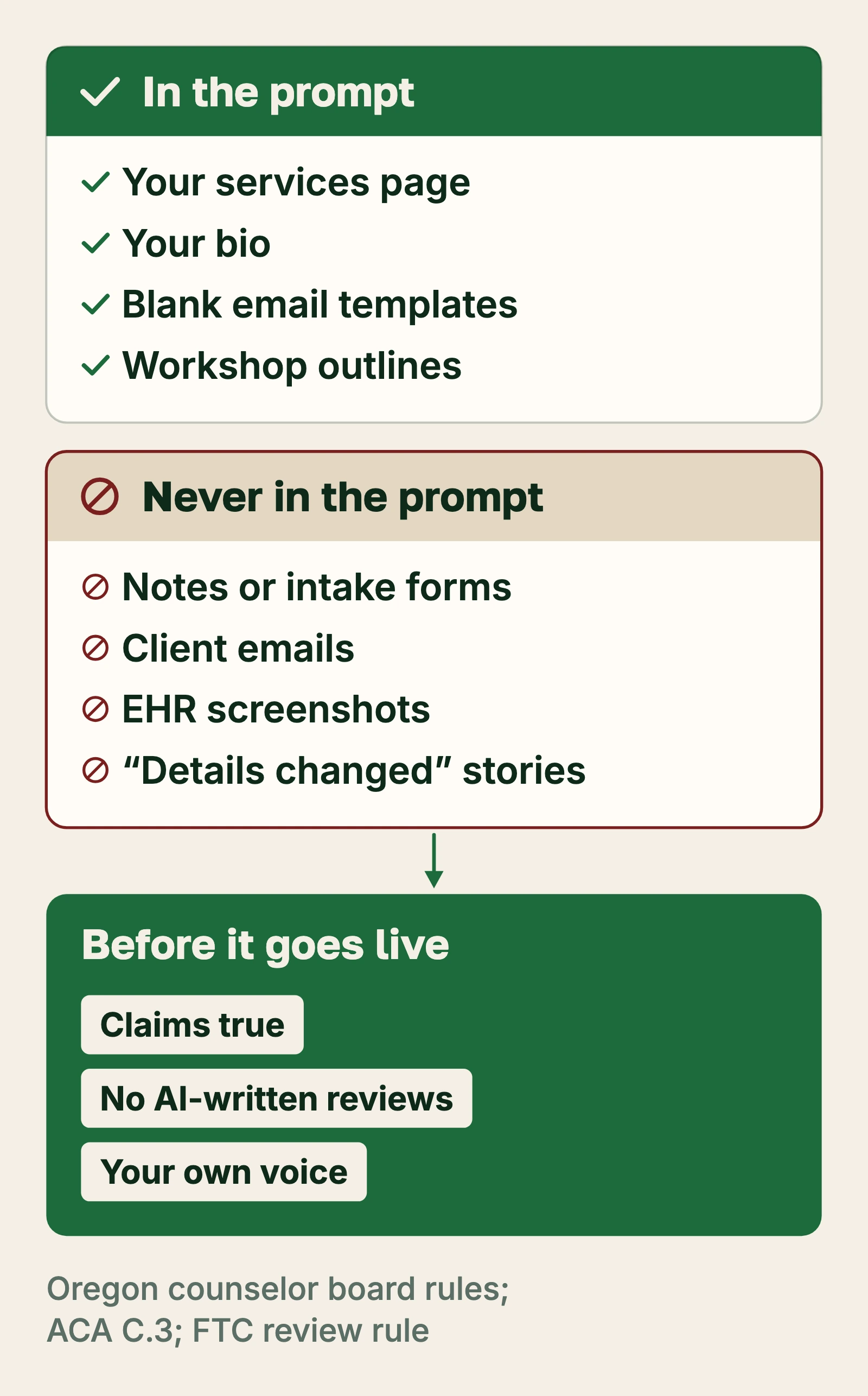
Good uses share one feature: the prompt holds nothing about any client. Rewriting your own services page, tightening an "about me" paragraph for your website or a profile, drafting a generic intake reminder, outlining a talk for a community group, or turning your office policies into plain language all qualify, as long as you write the prompt from scratch.
The line is any client information in a tool that has no business associate agreement with you. That rules out pasting a progress note to "make it sound better," an intake form, an email a client sent you, a screenshot of your calendar or EHR, and a "story with the details changed" about a real person. The test from HIPAA-safe AI tools applies here too: if the client could recognize themselves in the prompt, it stays out.
The same thinking covers your marketing vendors. An email platform that holds a list of client addresses, or a website form that collects messages from clients, is handling client information on your behalf, and HHS's business associate guidance treats that vendor as a business associate. Get the BAA before any client data reaches it.
What AI drafts get wrong in therapy copy
Language models write confident marketing prose, and confident prose is where advertising rules bite. Read every draft for these:
- Credentials you do not hold. A model asked for a "professional bio" will happily add a certification, a specialty, or a doctorate. Delete anything that is not on your license or your transcript.
- Outcome promises. "Proven," "guaranteed," "heal your trauma in eight sessions." These are claims you would have to stand behind.
- Invented social proof. Sample reviews, a quote from "a client," a star rating. Delete them all.
- Borrowed voice. Copy that sounds like every other practice page tells a reader nothing about you. Put your own sentences back in.
The Oregon counselor board's advertising rules
If you hold an LPC or LMFT license (or are a registered associate), the Oregon Board of Licensed Professional Counselors and Therapists sets the rules, collected on its laws and rules page. Two are on point. OAR 833-100-0012 says: "Advertisements must not be false, fraudulent, or misleading to the public. Testimonials from current clients are not solicited for advertising or other purposes due to the client's vulnerability to undue influence." And OAR 833-100-0011 adopts the 2014 ACA Code of Ethics as the board's code of conduct, so a violation of the code is grounds for discipline. Both are in the board's compiled statutes and rules (PDF).
The ACA Code reaches further than the board's own sentence. Under ACA C.3.b, counselors who use testimonials "do not solicit them from current clients, former clients, or any other persons who may be vulnerable to undue influence," and they discuss with clients the implications of, and obtain permission for, the use of any testimonial. C.3.a requires that credentials in advertising be stated accurately and not be "false, misleading, deceptive, or fraudulent." So for an LPC or LMFT the rule is current and former clients, plus anyone else vulnerable to undue influence, not current clients alone.
These rules bind the counselor board's licensees. LCSWs answer to the Board of Licensed Social Workers and psychologists to the Board of Psychology, each with its own rules and code; check yours rather than assuming this section covers you.
Fake reviews are a federal problem too
The Federal Trade Commission's rule on consumer reviews and testimonials, in effect since October 21, 2024 according to the FTC's questions and answers page, prohibits fake or false reviews and testimonials. The FTC's announcement names reviews that "misrepresent that they are by someone who does not exist, such as AI-generated fake reviews," and covers businesses that knew or should have known a review was fake. A chatbot-written "client quote" on your website is exactly that.
A prompt checklist, step by step
- Start from a blank prompt. Never paste from your EHR, inbox, or notes; type the request fresh.
- Describe the task, not a client. "Rewrite this paragraph about my approach to anxiety for a general reader" is fine. Anything about a specific person is not.
- Read the prompt once before you send it. No names, dates, places, session details, or anything a client could recognize.
- Tell the tool what to leave out. Ask it not to add credentials, statistics, testimonials, or promises of results.
- Check every factual claim in the draft. License type, training, years in practice, and modalities have to agree with your records. Compare against ACA C.3.a and C.4 if you are a counselor.
- Delete any testimonial or review the tool wrote. Real testimonials, if you use them at all, follow ACA C.3.b: never solicited from current or former clients or anyone vulnerable to undue influence.
- Rewrite it in your own voice. Read it aloud; change anything you would not say to a new client on the phone.
- Get a BAA before any client data reaches a marketing vendor. Email lists and contact forms count.
- Keep a dated copy of what you published. If a board ever asks about an ad, you will want the version that ran.
Your website itself has more to get right than copy; the website essentials lesson covers pages, accessibility, and privacy.
None of this is legal advice. I quoted the board's rules, the ACA Code, and the FTC and linked each one; your board or an attorney has the final word on a particular ad.
Further reading
- Oregon Board of Licensed Professional Counselors and Therapists: Laws and rules. The board's current statutes and administrative rules.
- Compiled statutes and OARs (PDF, revised February 2026). OAR 833-100-0011 and OAR 833-100-0012 are in Division 100.
- 2014 ACA Code of Ethics (PDF). Section C.3 on advertising and testimonials, C.4 on professional qualifications.
- FTC: Consumer reviews and testimonials rule, questions and answers. What the rule covers, in the agency's words.
- AI scribes and note tools. The previous lesson in this topic.
Sources
- “Laws and Rules.” Oregon Board of Licensed Professional Counselors and Therapists. https://www.oregon.gov/oblpct/pages/lawsrules.aspx (accessed Nov 16, 2026).
- “Statutes and Oregon Administrative Rules (Revised 2/26).” Oregon Board of Licensed Professional Counselors and Therapists. OAR 833-100-0012 (Preamble): advertisements not false, fraudulent, or misleading; testimonials from current clients not solicited. OAR 833-100-0011: adopts the 2014 ACA Code; violations are grounds for discipline. https://www.oregon.gov/oblpct/Documents/BLPCT_Statutes-OARs.pdf (accessed Nov 16, 2026).
- “2014 ACA Code of Ethics.” American Counseling Association. C.3.a Accurate Advertising; C.3.b Testimonials (current clients, former clients, or other persons vulnerable to undue influence; discuss implications and obtain permission); C.4 Professional Qualifications. https://www.counseling.org/docs/default-source/default-document-library/ethics/2014-aca-code-of-ethics.pdf (accessed Nov 16, 2026).
- “Business Associates.” U.S. Department of Health and Human Services, Office for Civil Rights. A vendor that creates, receives, maintains, or transmits PHI on a covered entity's behalf is a business associate. https://www.hhs.gov/hipaa/for-professionals/privacy/guidance/business-associates/index.html (accessed Nov 16, 2026).
- “Federal Trade Commission Announces Final Rule Banning Fake Reviews and Testimonials.” Federal Trade Commission, Aug 14, 2024. Covers reviews that misrepresent they are by someone who does not exist, such as AI-generated fake reviews. https://www.ftc.gov/news-events/news/press-releases/2024/08/federal-trade-commission-announces-final-rule-banning-fake-reviews-testimonials (accessed Nov 16, 2026).
- “Consumer Reviews and Testimonials Rule: Questions and Answers.” Federal Trade Commission. The rule went into effect on October 21, 2024 (16 CFR Part 465). https://www.ftc.gov/business-guidance/resources/consumer-reviews-testimonials-rule-questions-answers (accessed Nov 16, 2026).
Study guide
Where AI helps safely
- Work with no client information: services page, bio, generic templates, workshop outlines, plain-language policies
- Always from a fresh prompt, never pasted from your EHR, inbox, or notes
What never goes in a prompt without a BAA
- Notes, intake forms, client emails, screenshots of your EHR or calendar, "changed details" stories about real people
- Test: if the client could recognize themselves, it stays out
- Marketing vendors holding client data (email lists, contact forms) are business associates: BAA first
What to cut from AI drafts
- Credentials, specialties, or degrees you do not hold
- Outcome promises ("proven," "guaranteed")
- Invented reviews, quotes, or ratings
- Generic voice: put your own sentences back
Oregon counselor board rules (LPC, LMFT, associates)
- OAR 833-100-0012: advertisements must not be false, fraudulent, or misleading; testimonials from current clients are not solicited
- OAR 833-100-0011: adopts the 2014 ACA Code; violations are grounds for discipline
- ACA C.3.a: credentials stated accurately in advertising
- ACA C.3.b: no soliciting testimonials from current or former clients or anyone vulnerable to undue influence; discuss implications and get permission for any testimonial
- LCSWs and psychologists: their own boards and codes apply
Federal rule
- FTC consumer reviews and testimonials rule, in effect October 21, 2024: bans fake reviews and testimonials, including AI-generated reviews by people who do not exist
Checklist
- Blank prompt; describe the task, not a client
- Read the prompt before sending
- Tell the tool not to add credentials, statistics, testimonials, or promises
- Check every claim against your records
- Delete AI-written testimonials
- Rewrite in your own voice
- BAA before client data reaches a vendor
- Keep a dated copy of what you published
Official pages
Check what you learned
10 questions from this lesson. Answers are checked as you go; nothing is recorded.
1 / 10
Which of these is a safe use of a public AI chatbot with no BAA?
Hint
See "Safe work and the line you do not cross."
Work that holds nothing about any client, written from a fresh prompt, is the safe zone. Notes, client emails, and intake answers are client information.
2 / 10
A "story with the details changed" about a real client goes into a prompt. Why is that still a problem?
Hint
The recognition test from the previous lesson.
If the client could recognize themselves in the prompt, it stays out of any tool without a BAA.
3 / 10
Your email marketing platform will store a list of client email addresses. What comes first?
Hint
See the paragraph on marketing vendors.
A vendor holding client information on your behalf is a business associate, so the BAA comes before any client data reaches it.
4 / 10
What does the Oregon counselor board's preamble rule say about advertisements?
Hint
Quoted in "The Oregon counselor board's advertising rules."
The rule says advertisements must not be false, fraudulent, or misleading to the public.
5 / 10
How does the Oregon counselor board make the 2014 ACA Code binding on its licensees?
Hint
The board's general purpose and scope rule.
The board's rule adopts the 2014 ACA Code as its code of professional conduct, and violations are grounds for discipline.
6 / 10
Under ACA C.3.b, from whom do counselors who use testimonials not solicit them?
Hint
The ACA rule is broader than the board's own sentence.
C.3.b covers current clients, former clients, and any other persons who may be vulnerable to undue influence.
7 / 10
An Oregon LCSW reads this lesson. Which statement is accurate?
Hint
See the scope paragraph.
The counselor board's rules bind LPCs, LMFTs, and their associates. LCSWs and psychologists answer to their own boards and codes.
8 / 10
A chatbot adds a five-star "client quote" to your draft homepage. What should you do?
Hint
Think about both the board rules and the FTC rule.
An invented testimonial is false advertising and a fake review under the FTC rule. Delete it.
9 / 10
Since when has the FTC rule on consumer reviews and testimonials been in effect?
Hint
See "Fake reviews are a federal problem too."
The FTC's questions and answers page says the rule went into effect on October 21, 2024.
10 / 10
Which step does the lesson's checklist put before sending a prompt?
Hint
Step 3 of the checklist.
Read the prompt before sending it and remove anything a client could recognize.
Worth another look


