This lesson is for the Oregon clinician who works alone, or alone with a spouse, and left the workplace retirement plan behind with the last W-2 job. Nobody sets up a plan for you now. The two that most solo practices weigh are a SEP IRA and a one-participant 401(k), which providers usually sell as a "solo 401(k)". Below I cover how each one works, what the IRS lets a self-employed owner put in for 2026 and 2027, the deadlines (one of which changed twice in recent years), and the point where a CPA should run your numbers. It assumes a sole proprietorship, or a single-member LLC taxed as one. If you have made an S corporation election, you are an employee of your own company and the self-employed rules below do not apply as written; the S corp lesson explains the election, and your CPA should handle the plan math.
Two plans built for a practice of one
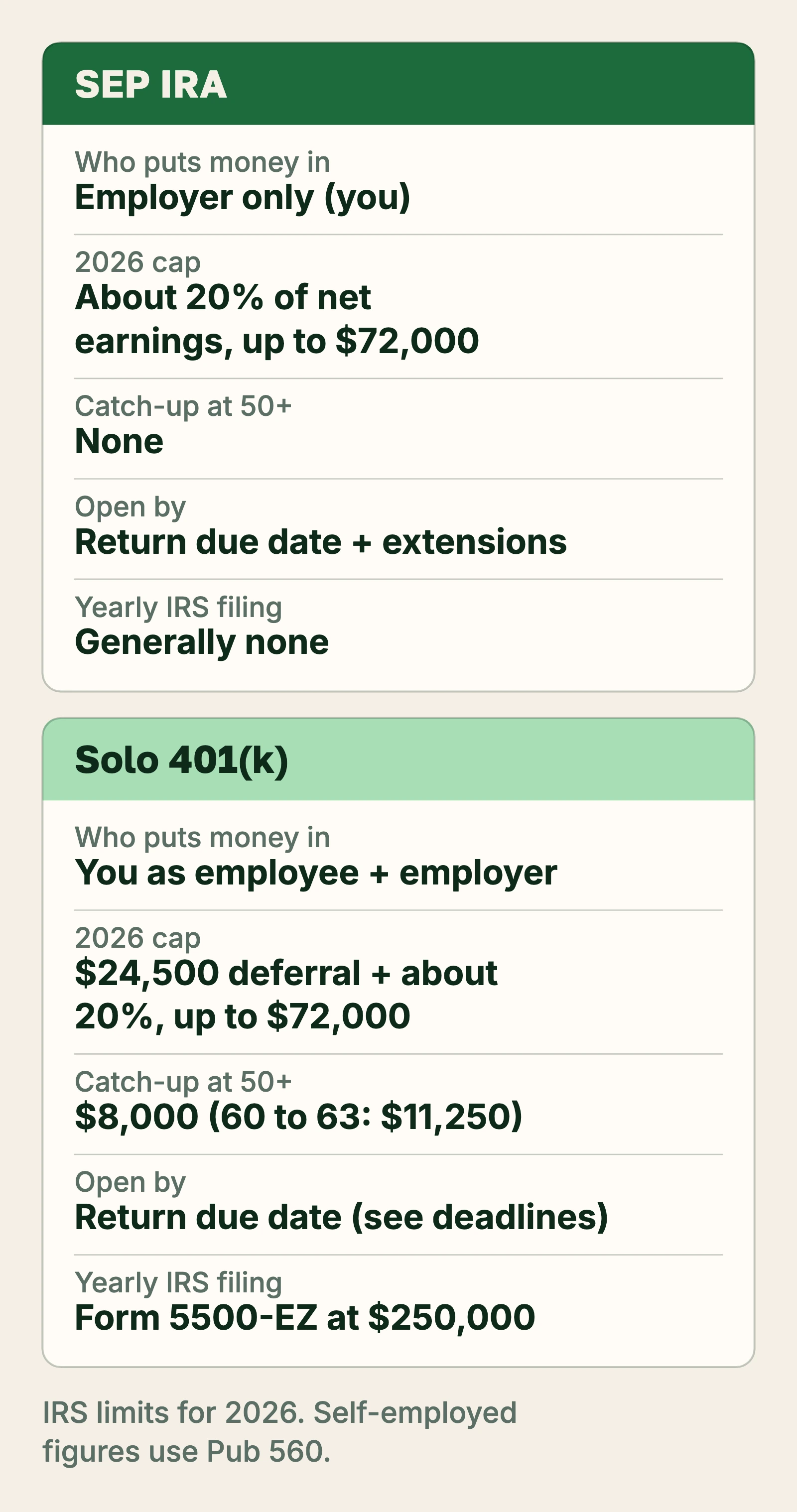
A SEP IRA is the simpler one. Only the employer contributes, and in a solo practice the employer is you. You adopt a written agreement, usually the IRS model Form 5305-SEP or a provider's prototype, and open a SEP IRA at a bank or brokerage. The IRS SEP page says the model form is not filed with the IRS and the employer generally has no annual filing, Form 5500 included. IRS Publication 560 adds that you do not have to contribute every year, which suits income that moves.
A one-participant 401(k) covers "a business owner with no employees, or that person and his or her spouse," in the words of the IRS one-participant 401(k) page. You put money in wearing two hats. As the employee you make elective deferrals, up to the annual deferral limit. As the employer you add a nonelective contribution on top. From age 50 the plan can also take catch-up contributions; a SEP has no employee deferral, so it has no catch-up either. The trade is paperwork: a plan document to sign and keep current and, once the plan holds $250,000 or more at the end of a year, an annual Form 5500-EZ.
Both plans assume nobody else works for you. Pub 560 says that when you make SEP contributions you must make them for every participant who worked during the year, under a written formula that does not favor you. The one-participant page warns that if you hire, eligible employees must come into the 401(k), and unless the plan is a safe harbor design their deferrals face nondiscrimination testing. If a first hire is likely soon, say so to whoever opens the account.
How much a self-employed owner can put in
The number that trips people up is 25 percent. The IRS describes the employer contribution as up to 25 percent of compensation, but for a self-employed owner, compensation means net earnings from self-employment after subtracting one-half of your self-employment tax and the contribution itself. The two figures depend on each other, so Pub 560 has you use a reduced rate. A 25 percent plan rate becomes 20 percent, and Pub 560 caps the deduction for these employer contributions at 20 percent of your net earnings from self-employment, figured before the contributions.
To put rough numbers on it: with $100,000 of Schedule C profit in 2026, my own arithmetic with the Pub 560 method, using the 15.3 percent rate on the IRS self-employment tax page, gives an employer contribution of about $18,600, not $25,000. In a solo 401(k), the employee deferral sits on top of that, which is why at modest profit the 401(k) usually allows more. Treat these as illustrations; your CPA's figure will move with your other income and deductions.
| Limit | 2026 | 2027 | Applies to |
|---|---|---|---|
| Total into the plan for you, not counting catch-ups | $72,000 | $75,000 | SEP and solo 401(k) |
| Employee elective deferral | $24,500 | $25,500 | Solo 401(k) |
| Catch-up, age 50 or older | $8,000 | $8,500 | Solo 401(k) |
| Catch-up if you turn 60, 61, 62, or 63 that year (instead of the line above) | $11,250 | $11,750 | Solo 401(k) |
| Most compensation the plan can count | $360,000 | $375,000 | Both |
The 2026 figures are on the IRS COLA table, which did not yet show 2027 when I checked. The 2027 figures come from IRS Notice 2026-66 and the IRS announcement of November 12, 2026, IR-2026-136.
One more rule the table hides: the deferral limit belongs to you, not to the plan. If you also work for a hospital or agency and defer into its 401(k), the one-participant page reminds owners that "limits on elective deferrals are by person, not by plan." Both deferrals count against the one limit.
Deadlines, and the rule that changed
A SEP is forgiving on time. Pub 560 lets you set one up "as late as the due date (including extensions)" of your income tax return for that year, and contributions made by that date count for the year.
The 401(k) deadline has changed twice, and older articles still repeat the original rule, that the plan had to exist by December 31.
- Employer contributions. For tax years beginning after 2019, an employer can adopt a new plan as late as the tax return due date, including extensions, and treat it as adopted on the last day of the year before. This is IRC 401(b)(2), added by the 2019 SECURE Act, and the IRS sets it out in its issue snapshot on contributions made after year end.
- Employee deferrals, first year only. Since 2023, under the SECURE 2.0 Act, a sole proprietor with no employees who adopts a new 401(k) after the year ends can still make elective deferrals for that first year. Pub 560 puts the deadline as "the tax filing deadline (without regard to extensions)," and the deferrals have to be paid into the plan by then. An extension buys more time for the employer part only.
Pub 560's qualified plan chapter still opens its set-up paragraph with the older sentence, that a plan "must be set up (adopted) by the last day of that year," before it turns to the sole proprietor case. I rely on the issue snapshot and the statute it cites, and I would ask the plan provider to confirm the dates in writing for your year.
In practice: a sole proprietor with no employees and no plan can still open a solo 401(k) early in 2027 and make 2026 deferrals, as long as the plan is adopted and the deferrals are paid in by the original due date of the 2026 return. Providers take time to open accounts, so I would not start in the last week.

The Oregon side
The plans themselves are federal. Oregon comes in through your income tax: the Department of Revenue's 2026 estimated tax instructions describe Oregon taxable income as your federal taxable income with Oregon's own additions, subtractions, and modifications. In the ordinary case, then, a contribution that lowers your federal taxable income lowers your Oregon tax as well, at Oregon's 2026 rates of 4.75 to 9.9 percent. If you pay quarterly estimates, tell your CPA about a large contribution before the next payment; the quarterly estimated taxes lesson covers those payments.
How to do it
- Get your net profit. Close the books for the year, or the year so far, and find net profit (Schedule C, line 31). The bookkeeping lesson covers the records behind it.
- Count who works in the practice. You alone, or you and a spouse, fits a one-participant 401(k). If anyone else is on payroll, ask a CPA about eligibility before you choose either plan.
- Choose the plan. If you want the least paperwork and expect to put in no more than the 20 percent figure, a SEP does that. If you want to save more than that at your profit level, or you are 50 or older and want catch-ups, look at a solo 401(k).
- Open the account. For a SEP, sign Form 5305-SEP or the provider's prototype, keep it with your records, and open the SEP IRA. For a solo 401(k), sign the provider's plan document and open the plan account.
- Write down the deadline for the year you are funding. SEP money and employer 401(k) money: the return due date, including extensions. First-year solo 401(k) deferrals: the return due date without extensions.
- Figure your employer contribution with the Rate Table and the Deduction Worksheet for Self-Employed in chapter 5 of Pub 560, or hand the worksheet to your CPA.
- Make the deposits from the practice account, and tell the provider which tax year each one is for, so a January deposit lands in the year you meant.
- Take the deduction. Pub 560 says sole proprietors deduct contributions for themselves on line 16 of Schedule 1 (Form 1040).
- Watch the balance. When a solo 401(k) holds $250,000 or more at the end of a year, file Form 5500-EZ for that year.
- Recheck the limits every fall on the IRS COLA table and in the IRS announcement for the coming year. The 2027 figures came out on November 12, 2026.
Where a CPA earns the fee
I am not recommending one plan over the other. The choice turns on numbers: the year's profit, whether you defer into another employer's plan, whether a spouse works in the practice, whether a hire is coming, and whether pre-tax or Roth money suits you (Pub 560 notes a SEP IRA can now be a Roth SEP IRA). Bring those to a CPA in the fall, while every deadline above is still open.
None of this is legal, tax, or financial advice. I wrote down what the IRS's own pages say and linked each one; a CPA or financial professional gets the final word on how it applies to you.
Further reading
- IRS Publication 560, Retirement Plans for Small Business. The handbook, with the self-employed rate table and deduction worksheet. The current edition is for 2025 returns.
- IRS: One-participant 401(k) plans. Who qualifies, the two kinds of contribution, and the Form 5500-EZ threshold.
- IRS: Simplified Employee Pension Plan (SEP). Setting up a SEP and the employer's filing duties.
- IRS: COLA increases for dollar limitations. The year-by-year limits table to recheck each fall.
- IRS Notice 2026-66 (PDF). The official 2027 limits.
- IRS issue snapshot: employer contributions to a 401(k) made after year end. The post-2019 adoption rule and the sole proprietor deferral rule, with examples.
Sources
- “Publication 560 (2025), Retirement Plans for Small Business.” Internal Revenue Service. SEP set-up deadline; 20% of net earnings for self-employed; 2023 sole proprietor 401(k) deferral rule; Schedule 1 line 16; Roth SEP IRA. https://www.irs.gov/publications/p560 (accessed Nov 16, 2026).
- “One-participant 401(k) plans.” Internal Revenue Service. Owner or owner and spouse; deferrals by person, not by plan; earned income after one-half of SE tax; Form 5500-EZ at $250,000. Last reviewed Apr 9, 2026. https://www.irs.gov/retirement-plans/one-participant-401k-plans (accessed Nov 16, 2026).
- “Simplified Employee Pension Plan (SEP).” Internal Revenue Service. Only the employer contributes; Form 5305-SEP not filed; no Form 5500. Last reviewed May 7, 2026. https://www.irs.gov/retirement-plans/plan-sponsor/simplified-employee-pension-plan-sep (accessed Nov 16, 2026).
- “Form 5305-SEP (PDF).” Internal Revenue Service. https://www.irs.gov/pub/irs-pdf/f5305sep.pdf (accessed Nov 16, 2026).
- “About Form 5500-EZ.” Internal Revenue Service. https://www.irs.gov/forms-pubs/about-form-5500-ez (accessed Nov 16, 2026).
- “COLA increases for dollar limitations on benefits and contributions.” Internal Revenue Service. 2026 limits: $72,000, $24,500, $8,000, $11,250, $360,000. Last reviewed Aug 24, 2026; 2027 not yet shown. https://www.irs.gov/retirement-plans/cola-increases-for-dollar-limitations-on-benefits-and-contributions (accessed Nov 16, 2026).
- “Notice 2026-66: 2027 amounts relating to retirement plans and IRAs (PDF).” Internal Revenue Service, Nov 12, 2026. 2027 limits: $75,000, $25,500, $8,500, $11,750, $375,000. https://www.irs.gov/pub/irs-drop/n-26-66.pdf (accessed Nov 16, 2026).
- “IR-2026-136: 401(k) limit increases to $25,500 for 2027, IRA limit remains $7,500.” Internal Revenue Service, Nov 12, 2026. https://www.irs.gov/newsroom/401k-limit-increases-to-25500-for-2027-ira-limit-remains-7500 (accessed Nov 16, 2026).
- “Issue snapshot: deductibility of employer contributions to a 401(k) plan made after the end of the tax year.” Internal Revenue Service. IRC 401(b)(2) adoption by the return due date including extensions; SECURE 2.0 sole proprietor deferrals by the due date without extensions. Last reviewed Jun 27, 2026. https://www.irs.gov/retirement-plans/issue-snapshot-deductibility-of-employer-contributions-to-a-401k-plan-made-after-the-end-of-the-tax-year (accessed Nov 16, 2026).
- “Self-employment tax (Social Security and Medicare taxes).” Internal Revenue Service. 15.3% rate. Last reviewed Oct 30, 2026. https://www.irs.gov/businesses/small-businesses-self-employed/self-employment-tax-social-security-and-medicare-taxes (accessed Nov 16, 2026).
- “Publication OR-ESTIMATE 2026 (PDF).” Oregon Department of Revenue. Oregon taxable income starts from federal taxable income; 2026 rate chart 4.75% to 9.9%. Rev. 10-07-25. https://www.oregon.gov/dor/forms/FormsPubs/publication-or-estimate_101-026_2026.pdf (accessed Nov 16, 2026).
Study guide
Two plans for a practice of one
- SEP IRA: only the employer (you) contributes; adopt Form 5305-SEP or a prototype (not filed with the IRS); generally no Form 5500; you need not contribute every year
- One-participant 401(k): covers an owner with no employees, or owner and spouse; employee deferrals plus an employer nonelective contribution; catch-ups from age 50; Form 5500-EZ once assets reach $250,000 at year end
- Hiring changes both: SEP contributions must go to every eligible participant under a written formula; a 401(k) must bring in eligible employees and face nondiscrimination testing
How much you can put in
- For a sole proprietor, 25 percent of compensation works out to about 20 percent of net earnings from self-employment, after one-half of SE tax; use the Pub 560 rate table and worksheet
- Rough illustration: $100,000 of 2026 Schedule C profit gives about $18,600 of employer contribution; in a solo 401(k) the deferral sits on top
- Deferral limits are by person, not by plan: another employer's 401(k) shares the same limit
| Limit | 2026 | 2027 |
|---|---|---|
| Total into the plan, not counting catch-ups | $72,000 | $75,000 |
| Employee deferral (401(k) only) | $24,500 | $25,500 |
| Catch-up, 50 or older (401(k) only) | $8,000 | $8,500 |
| Catch-up, turning 60 to 63 (instead) | $11,250 | $11,750 |
| Compensation the plan can count | $360,000 | $375,000 |
Deadlines
- SEP: set up and fund by the return due date, including extensions
- New 401(k), employer money: adopt by the return due date including extensions (IRC 401(b)(2), tax years after 2019)
- New solo 401(k), first-year deferrals (2023 on, sole proprietor, no employees): adopt and pay in by the return due date without extensions
- Pub 560 still prints the older year-end sentence; the IRS issue snapshot has the current rule
Oregon
- Oregon taxable income starts from federal taxable income, so a deductible contribution usually lowers Oregon tax too (2026 rates 4.75 to 9.9 percent)
How to do it
- Net profit from the books; count who works in the practice; choose; open the account; write down the deadline; figure the contribution with Pub 560; deposit and name the tax year; deduct on Schedule 1, line 16; watch the $250,000 line; recheck limits every fall
Key terms
- Elective deferral: money you put in as the employee, from your own earnings
- Nonelective contribution: money the business puts in as the employer
- Catch-up: an extra deferral allowed from age 50
- Net earnings from self-employment: profit after the deduction for one-half of SE tax, the base for the 20 percent figure
Official pages
Check what you learned
10 questions from this lesson. Answers are checked as you go; nothing is recorded.
1 / 10
Who contributes to a SEP IRA in a solo practice?
Hint
See "Two plans built for a practice of one."
The IRS SEP page says only the employer contributes to a SEP, and in a solo practice the owner is the employer.
2 / 10
Who can a one-participant (solo) 401(k) cover?
Hint
The lesson quotes the IRS one-participant 401(k) page.
The IRS describes it as a 401(k) covering a business owner with no employees, or that person and his or her spouse.
3 / 10
For a sole proprietor, what does a 25 percent plan contribution rate work out to?
Hint
Look for the reduced rate in the contribution section.
Because compensation is figured after one-half of SE tax and the contribution itself, Pub 560 reduces a 25 percent rate to 20 percent of net earnings from self-employment.
4 / 10
What is the 2026 limit on employee elective deferrals to a 401(k), before catch-ups?
Hint
Check the 2026 column of the limits table.
The IRS COLA table lists $24,500 for 2026. $25,500 is the 2027 figure from Notice 2026-66.
5 / 10
What is the 2026 limit on total contributions into one plan for one person, not counting catch-ups?
Hint
The first row of the limits table.
The 2026 defined contribution limit is $72,000. It rises to $75,000 for 2027.
6 / 10
Which plan lets a 55-year-old solo owner add catch-up contributions?
Hint
Catch-ups ride on employee deferrals.
A SEP takes only employer contributions, so it has no catch-up. A solo 401(k) can take catch-up contributions from age 50.
7 / 10
How late can you set up a SEP for a tax year?
Hint
See "Deadlines, and the rule that changed."
Pub 560 says you can set up a SEP for any year as late as the due date, including extensions, of your income tax return for that year.
8 / 10
Since 2023, a sole proprietor with no employees adopts a new solo 401(k) after year end. By when must first-year elective deferrals be paid in?
Hint
An extension helps the employer part only.
Under SECURE 2.0, Pub 560 and the IRS issue snapshot set the deadline as the tax filing deadline, determined without regard to extensions.
9 / 10
You defer into a hospital job's 401(k) and also into your own solo 401(k). How does the deferral limit apply?
Hint
The lesson quotes the IRS on this.
The IRS one-participant page says limits on elective deferrals are by person, not by plan.
10 / 10
When must a one-participant 401(k) generally start filing Form 5500-EZ?
Hint
See step 9 of "How to do it."
The IRS says a one-participant plan generally must file Form 5500-EZ once it has $250,000 or more in assets at the end of the year.
Worth another look


