read the transcript
- oregon quarterly taxes: not just the irs.
- april 15. june 15. september 15. january 15. (tax year 2026; january 15, 2027)
- the irs and oregon each get their own payment
- the 110% safe harbor is federal only
- quarterly. pay the irs and oregon on each date, and set two reminders.
- the full lesson, link typed
- business education, not legal or billing advice.
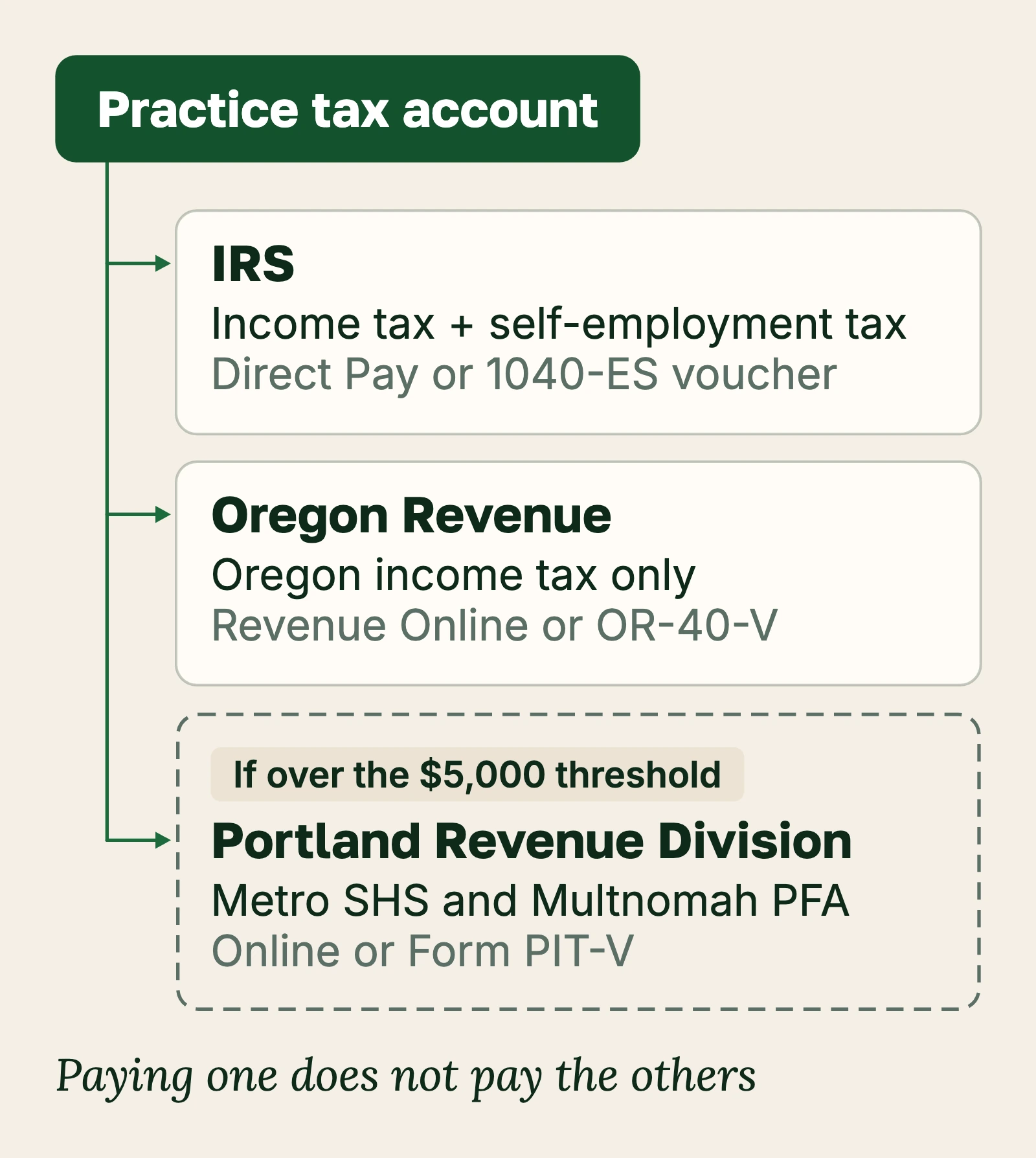
This lesson is for the Oregon clinician whose income no longer arrives with tax already taken out. A W-2 job withholds every payday; a private practice does not, and the tax is still due through the year, not in April. You pay it in four installments called estimated taxes. The part people miss is how many places the money goes. Every Oregon practice owner who owes deals with the IRS and the Oregon Department of Revenue, and some in the Portland area also owe the City of Portland Revenue Division for two regional taxes. Each is a separate payment to a separate agency, with its own rules, and paying one does not pay the others. The S corp lesson lists the 2026 dates on one page; this one covers how to work out and make the payments.
Who has to pay
Federal. The IRS estimated taxes page says individuals, sole proprietors included, generally have to pay estimated tax if they expect to owe $1,000 or more when they file. For a practice owner the federal figure includes self-employment tax, which the IRS self-employment tax page puts at 15.3 percent (12.4 percent Social Security, 2.9 percent Medicare).
Oregon. Oregon's Publication OR-ESTIMATE for 2026 uses the same $1,000 line: you must pay estimates if you expect to owe $1,000 or more after all credits and withholding. The Oregon figure leaves out Social Security, Medicare, and self-employment tax, so the state payment is figured on income tax alone, at Oregon's rates.
Portland area. If you live or work in the Metro district or Multnomah County, two more income taxes may apply: the Metro Supportive Housing Services tax (SHS, 1 percent above a threshold; for 2026, $128,000 of taxable income single or $205,000 joint) and the Multnomah County Preschool for All tax (PFA, 1.5 percent above $125,000 single or $200,000 joint, plus another 1.5 percent above $250,000 or $400,000). Both are paid to the City of Portland Revenue Division, not to the state. The Revenue Division's personal tax page says that through 2025, estimated payments were required for a program when the tax for it was $1,000 or more this year and last year, and that "beginning in tax year 2026 and for all subsequent years, this threshold increases to $5,000."
By my arithmetic from those published rates, a single filer reaches $5,000 of PFA tax at about $354,000 of Multnomah County taxable income, and $5,000 of SHS tax at about $628,000 of Metro taxable income. So for 2026, most solo clinicians who owe SHS or PFA will settle it with the return rather than in quarterly installments. They still owe it, and they still file the return.
The 2026 dates
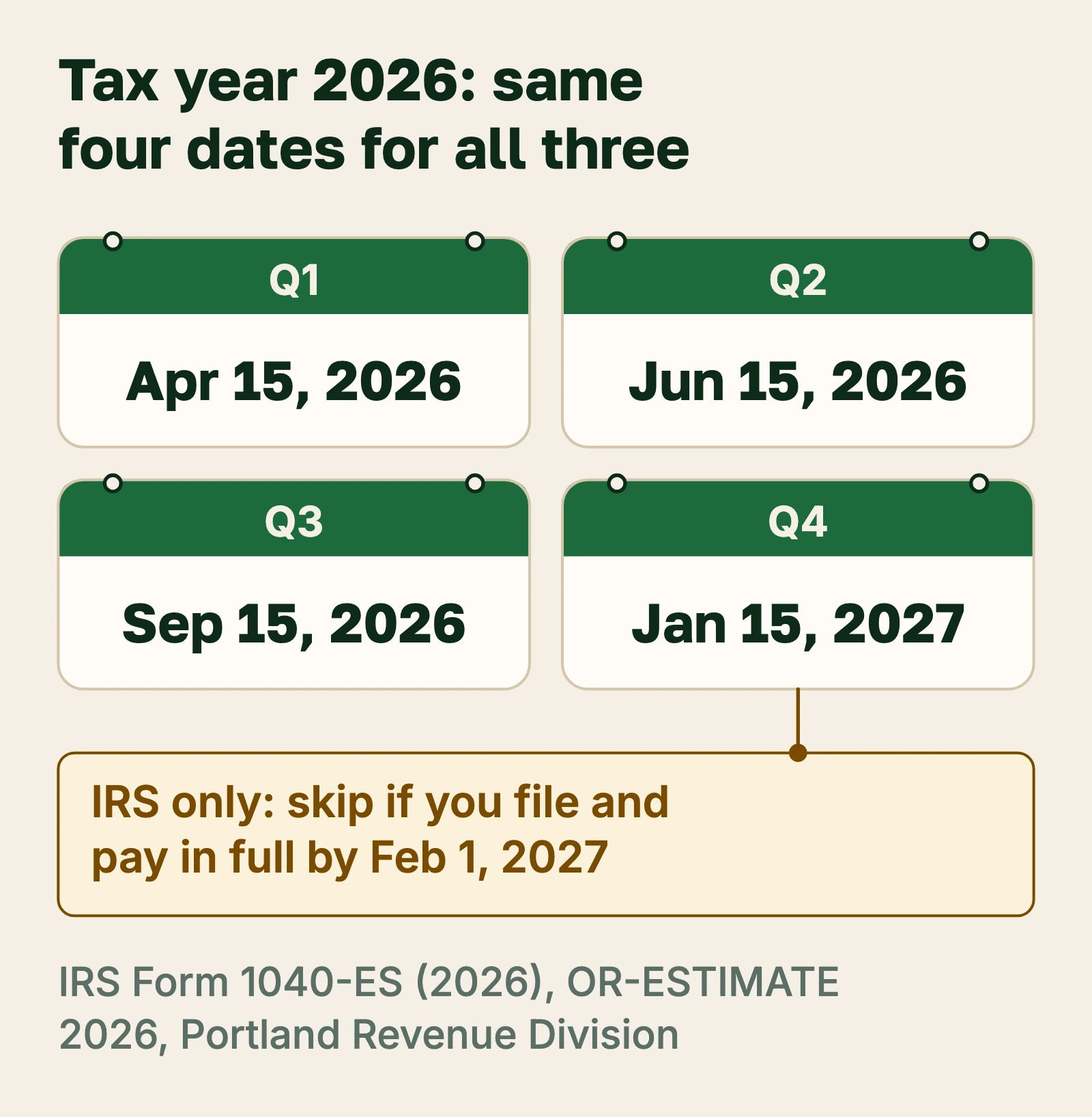
For tax year 2026, the 2026 Form 1040-ES sets the federal due dates as April 15, June 15, and September 15, 2026, and January 15, 2027. OR-ESTIMATE lists the same four dates for Oregon, and moves a date that lands on a weekend or an Oregon legal holiday to the next business day. Portland's Revenue Division uses April 15, June 15, September 15, and January 15 for SHS and PFA.
One federal shortcut: you do not have to make the January 15, 2027 payment if you file your 2026 return by February 1, 2027 and pay the entire balance with it. That is in the 1040-ES instructions. OR-ESTIMATE has no matching exception, so keep the January Oregon payment on the calendar.
The IRS has not yet published the 2027 Form 1040-ES. When it does, take the 2027 dates from the form, including the January 2028 date.
How much is enough: the safe harbors
Nobody knows the year's income in April, so both systems let you aim at a fixed target instead. The federal rule, from the IRS estimated taxes page, is that you generally avoid the underpayment penalty if you paid at least 90 percent of this year's tax or 100 percent of last year's, whichever is smaller. The 2026 Form 1040-ES adds a rule for higher incomes: if your 2025 adjusted gross income was more than $150,000 ($75,000 married filing separately), use 110 percent of last year's tax instead of 100 percent.
Oregon's version, in OR-ESTIMATE, is the lesser of 90 percent of your 2026 tax after credits or 100 percent of your 2025 tax after credits. OR-ESTIMATE sets out no higher-income version; its safe harbor stays at 100 percent. To use it, you have to file your 2025 Oregon return before your 2026 one.
| Question | IRS | Oregon |
|---|---|---|
| Who must pay | Expect to owe $1,000 or more | Expect to owe $1,000 or more after credits and withholding |
| What is counted | Income tax plus self-employment tax | Income tax only; no Social Security, Medicare, or self-employment tax |
| Prior-year safe harbor | 100% of 2025 tax; 110% if 2025 AGI was over $150,000 ($75,000 married filing separately) | 100% of 2025 tax after credits, no higher-income version |
| If you underpay | A penalty, figured on Form 2210 | Underpayment interest, figured on Form OR-10 |
| How to pay | Direct Pay, your IRS online account, EFTPS, or a check with a 1040-ES voucher | Revenue Online, or a check with Form OR-40-V |
Sources: the IRS estimated taxes page, the 2026 Form 1040-ES, and OR-ESTIMATE 2026, all linked above. Portland's SHS and PFA estimates follow a similar 90 percent or 100 percent test and charge interest on a shortfall, per the Revenue Division's page.
Paying each one
IRS. IRS Direct Pay moves money from a checking or savings account with no sign-in; choose estimated tax and the 2026 tax year. The same page says you can change or cancel a scheduled payment up to 2 days before it goes. Your IRS online account also takes estimated payments and, per the 1040-ES instructions, shows your payment history, which helps at filing time.
Oregon. The Department of Revenue's payments page points to Revenue Online, where payments from a bank account are free and cards carry a fee; quarterly estimated is one of the payment types. To pay by check instead, use Form OR-40-V, mark the "Estimated payment" box, make the check payable to "Oregon Department of Revenue," and write "2026 OR-40-V" and the last four digits of your Social Security number on it, as OR-ESTIMATE instructs.
Portland. The Revenue Division's pay personal tax page takes estimated payments online (bank transfers carry no fee; cards carry a 2.45 percent fee) or by mail with Form PIT-V, one voucher and one check per program.
How to do it
- Pull last year's returns. Write down the total tax on your 2025 federal return, the tax after credits on your 2025 Oregon return, and your 2025 adjusted gross income.
- Check the 110% line. If 2025 AGI was over $150,000 ($75,000 married filing separately), your federal prior-year target is 110 percent of 2025 tax. Oregon's stays at 100 percent.
- Pick a target for each agency. The prior-year safe harbor is the simplest, because it does not move when income does. Divide each target by four.
- Close the books every month. Note year-to-date profit, so you can see early whether this year is running well above or below last year. The bookkeeping lesson covers the records.
- Pay the IRS on each due date through Direct Pay: estimated tax, 1040-ES, tax year 2026. Keep the confirmation.
- Pay Oregon the same day through Revenue Online, from the Department of Revenue payments page, choosing the quarterly estimated type and 2026.
- Pay Portland, if you are over its threshold, through the Revenue Division payment page, once for SHS and once for PFA.
- Set two reminders per due date: one a week ahead to move money into the tax account, one on the day.
- Refigure midyear if income shifts. IRS Publication 505 and OR-ESTIMATE each have an amended estimated tax worksheet that spreads the new amount over the payments left.
- At filing, list every payment by agency and date, from your Direct Pay confirmations, your IRS online account, and Revenue Online, so each one is credited to the right return.
When to bring in a CPA
Have a CPA look at your first year of estimates, and again in any year when the practice changes shape: an S corporation election (salary withholding then covers part of the tax), a big jump in profit, a move into or out of the Portland area, or a large retirement contribution. The retirement accounts lesson covers that last one.
None of this is legal, tax, or accounting advice. I wrote down what the agencies' own pages say and linked each one; a CPA gets the final word on what you should pay.
Further reading
- IRS Form 1040-ES for 2026 (PDF). The worksheet, the four dates, the 110% rule, and the January exception.
- IRS Publication 505, Tax Withholding and Estimated Tax. The long version, with the amended estimated tax worksheet and the annualized method for uneven income.
- Oregon Publication OR-ESTIMATE 2026 (PDF). Oregon's worksheet, its safe harbor, and the payment instructions.
- City of Portland Revenue Division: personal tax. SHS and PFA rates, thresholds by year, and the estimated payment rules.
- IRS: Estimated taxes. The short federal overview, including when the penalty can be waived.
Sources
- “Estimated taxes.” Internal Revenue Service. $1,000 threshold; 90% current-year or 100% prior-year safe harbor; payment methods. Last reviewed Sep 25, 2026. https://www.irs.gov/businesses/small-businesses-self-employed/estimated-taxes (accessed Nov 16, 2026).
- “Form 1040-ES (2026), Estimated Tax for Individuals (PDF).” Internal Revenue Service. Due dates Apr 15, Jun 15, Sep 15, 2026 and Jan 15, 2027; skip Jan 15 if filed by Feb 1, 2027 and paid in full; 110% if 2025 AGI over $150,000. https://www.irs.gov/pub/irs-pdf/f1040es.pdf (accessed Nov 16, 2026).
- “Publication 505, Tax Withholding and Estimated Tax.” Internal Revenue Service. 2026 edition; higher-income 110% rule; amended estimated tax worksheet. https://www.irs.gov/publications/p505 (accessed Nov 16, 2026).
- “Direct Pay with bank account.” Internal Revenue Service. No sign-in required; estimated tax is a payment reason; change or cancel within 2 days of the scheduled date. Last reviewed Sep 17, 2026. https://www.irs.gov/payments/direct-pay-with-bank-account (accessed Nov 16, 2026).
- “Your online account.” Internal Revenue Service. https://www.irs.gov/payments/your-online-account (accessed Nov 16, 2026).
- “Self-employment tax (Social Security and Medicare taxes).” Internal Revenue Service. 15.3% rate: 12.4% Social Security, 2.9% Medicare. Last reviewed Oct 30, 2026. https://www.irs.gov/businesses/small-businesses-self-employed/self-employment-tax-social-security-and-medicare-taxes (accessed Nov 16, 2026).
- “Publication OR-ESTIMATE 2026, Oregon Estimated Income Tax Instructions (PDF).” Oregon Department of Revenue. $1,000 threshold; excludes FICA and SE tax; lesser of 90% of 2026 or 100% of 2025 tax; same four dates; OR-40-V instructions; interest on Form OR-10. Rev. 10-07-25. https://www.oregon.gov/dor/forms/FormsPubs/publication-or-estimate_101-026_2026.pdf (accessed Nov 16, 2026).
- “Personal income tax payments.” Oregon Department of Revenue. Revenue Online; bank payments free; card fee; quarterly estimated payment type. https://www.oregon.gov/dor/programs/individuals/pages/personal-income-tax-payments.aspx (accessed Nov 16, 2026).
- “Form OR-40-V instructions (PDF).” Oregon Department of Revenue. https://www.oregon.gov/dor/forms/FormsPubs/form-or-40-v-instructions_101-172-1.pdf (accessed Nov 16, 2026).
- “Personal tax (Metro SHS and Multnomah County PFA).” City of Portland Revenue Division. SHS 1%, 2026 threshold $128,000/$205,000; PFA 1.5% and 3%; estimate threshold $5,000 from tax year 2026; due Apr 15, Jun 15, Sep 15, Jan 15. https://www.portland.gov/revenue/personal-tax (accessed Nov 16, 2026).
- “Pay your personal tax.” City of Portland Revenue Division. Online estimated payments; ACH no fee; cards 2.45% fee; Form PIT-V by mail, one per program. https://www.portland.gov/revenue/pay-personal-tax (accessed Nov 16, 2026).
Study guide
Who has to pay
- IRS: expect to owe $1,000 or more at filing; the federal figure includes self-employment tax (15.3 percent)
- Oregon: expect to owe $1,000 or more after credits and withholding; income tax only, no Social Security, Medicare, or SE tax
- Portland area: Metro SHS (1 percent; 2026 threshold $128,000 single, $205,000 joint) and Multnomah PFA (1.5 percent above $125,000 single or $200,000 joint, plus 1.5 percent above $250,000 or $400,000), paid to the City of Portland Revenue Division
- SHS and PFA estimated payments: $5,000 threshold from tax year 2026 (it was $1,000); many solo clinicians who owe will pay with the return
Tax year 2026 dates
- April 15, June 15, September 15, 2026, and January 15, 2027, for the IRS, Oregon, and Portland
- Federal only: skip January 15, 2027 if you file the 2026 return by February 1, 2027 and pay in full; Oregon has no such exception
- Oregon moves a weekend or Oregon holiday date to the next business day
- 2027 dates: take them from the 2027 Form 1040-ES when the IRS publishes it
| Question | IRS | Oregon |
|---|---|---|
| Prior-year safe harbor | 100%; 110% if 2025 AGI over $150,000 ($75,000 MFS) | 100% after credits, no higher-income version |
| Current-year safe harbor | 90% | 90% |
| Shortfall | Penalty, Form 2210 | Interest, Form OR-10 |
| Pay online | Direct Pay, online account, EFTPS | Revenue Online |
| Pay by check | 1040-ES voucher | Form OR-40-V, "Estimated payment" box |
How to do it
- Pull 2025 tax and AGI; check the 110% line; pick a target per agency and divide by four
- Close the books monthly; pay IRS, Oregon, and (if over threshold) Portland on each date
- Two reminders per date; refigure midyear with the amended worksheet; list every payment at filing
Key terms
- Safe harbor: a payment target that avoids the penalty or interest even if the year's tax turns out higher
- Form 1040-ES: the federal estimated tax worksheet and vouchers
- OR-ESTIMATE: Oregon's estimated tax instructions
- SHS / PFA: the Metro and Multnomah County income taxes paid to Portland's Revenue Division
Official pages
Check what you learned
10 questions from this lesson. Answers are checked as you go; nothing is recorded.
1 / 10
When must an individual generally make federal estimated tax payments?
Hint
See "Who has to pay."
The IRS estimated taxes page sets the line at expecting to owe $1,000 or more when the return is filed.
2 / 10
What is the first federal estimated tax due date for tax year 2026?
Hint
Check "The 2026 dates."
The 2026 Form 1040-ES lists April 15, June 15, and September 15, 2026, and January 15, 2027.
3 / 10
Which tax does Oregon leave out of its estimated tax calculation?
Hint
Oregon's figure is income tax alone.
OR-ESTIMATE says not to include Social Security, self-employment, or household employment tax.
4 / 10
Your 2025 AGI was $180,000 and you file single. What prior-year federal safe harbor applies for 2026?
Hint
Look for the higher-income rule in the 1040-ES.
If 2025 AGI was over $150,000 ($75,000 married filing separately), the 2026 Form 1040-ES substitutes 110% for 100%.
5 / 10
Does Oregon raise its prior-year safe harbor to 110% for higher incomes?
Hint
Compare the two rows in the side-by-side table.
OR-ESTIMATE's safe harbor is 100% of the 2025 tax after credits, with no higher-income version.
6 / 10
When can you skip the federal payment due January 15, 2027?
Hint
It is a federal shortcut only.
The 2026 Form 1040-ES allows this. OR-ESTIMATE has no matching exception, so the Oregon January payment stays.
7 / 10
What does Oregon charge when estimated payments fall short?
Hint
See the "If you underpay" row.
OR-ESTIMATE says underpayment interest is charged and reported on Form OR-10.
8 / 10
You pay your Oregon estimate by check. Which voucher goes with it?
Hint
See "Paying each one."
OR-ESTIMATE says to use Form OR-40-V for a check or money order and to mark the Estimated payment box.
9 / 10
Who collects estimated payments for the Metro SHS and Multnomah County PFA taxes?
Hint
Paying one agency does not pay the others.
Both taxes are paid to the City of Portland Revenue Division, separately from the IRS and the state.
10 / 10
From tax year 2026, what tax amount triggers SHS or PFA estimated payments?
Hint
The threshold rose for 2026.
The Revenue Division's page says the threshold was $1,000 through 2025 and increases to $5,000 beginning in tax year 2026.
Worth another look


