read the transcript
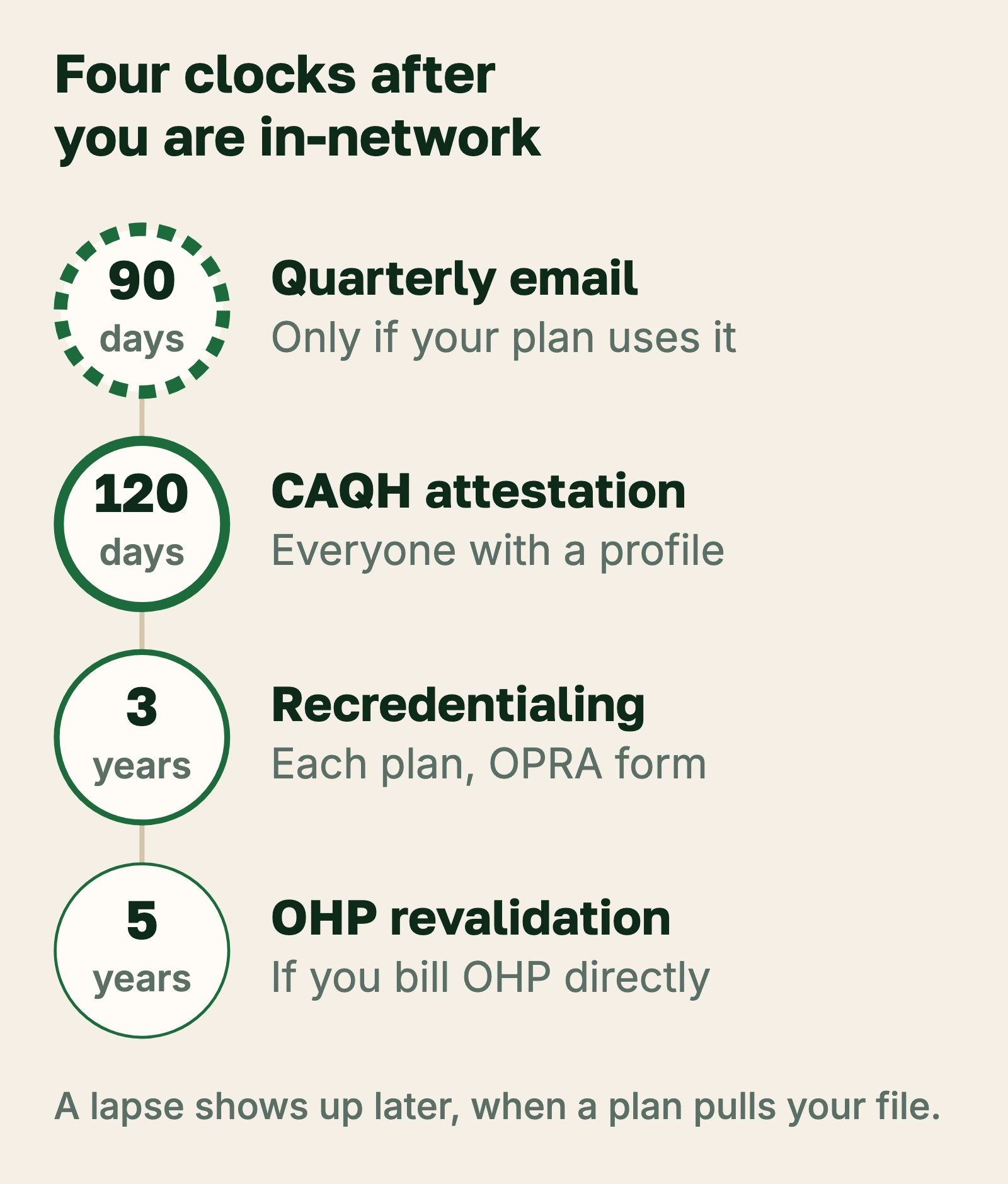
- on the panel? four clocks are running.
- about every 90 days: the quarterly email (if your plan uses dataspring)
- every 120 days: caqh attestation, even if nothing changed
- every 3 years: recredentialing.
- every 5 years: ohp revalidation. (if you bill ohp directly)
- attest. miss the 120-day attestation and your caqh profile goes to expired.
- the full lesson, link typed
- business education, not legal or billing advice.
This lesson starts where How to get credentialed stops. Once a plan has said yes and the contract is signed, credentialing turns into upkeep: a handful of clocks running at different speeds, each kept by a different organization. A lapse rarely hurts on the day it happens. It shows up months later, when a plan pulls your file for recredentialing and finds something stale. If the words credentialed, paneled, and in-network still blur together, read the vocabulary lesson first.
Four clocks, four keepers
Here is what runs once you are in-network, from fastest to slowest. Each row links to the page that sets it, and I checked every one in November 2026.
| Clock | How often | Who sets it |
|---|---|---|
| Quarterly confirmation email | About every 90 days, only if one of your plans uses DataSpring for it | DataSpring FAQ |
| CAQH attestation | Every 120 days | DataSpring FAQ |
| Recredentialing | At least every three years | NCQA; for CCOs, OAR 410-141-3510 |
| OHP revalidation | At least every five years | OHA provider enrollment |
The 120-day attestation
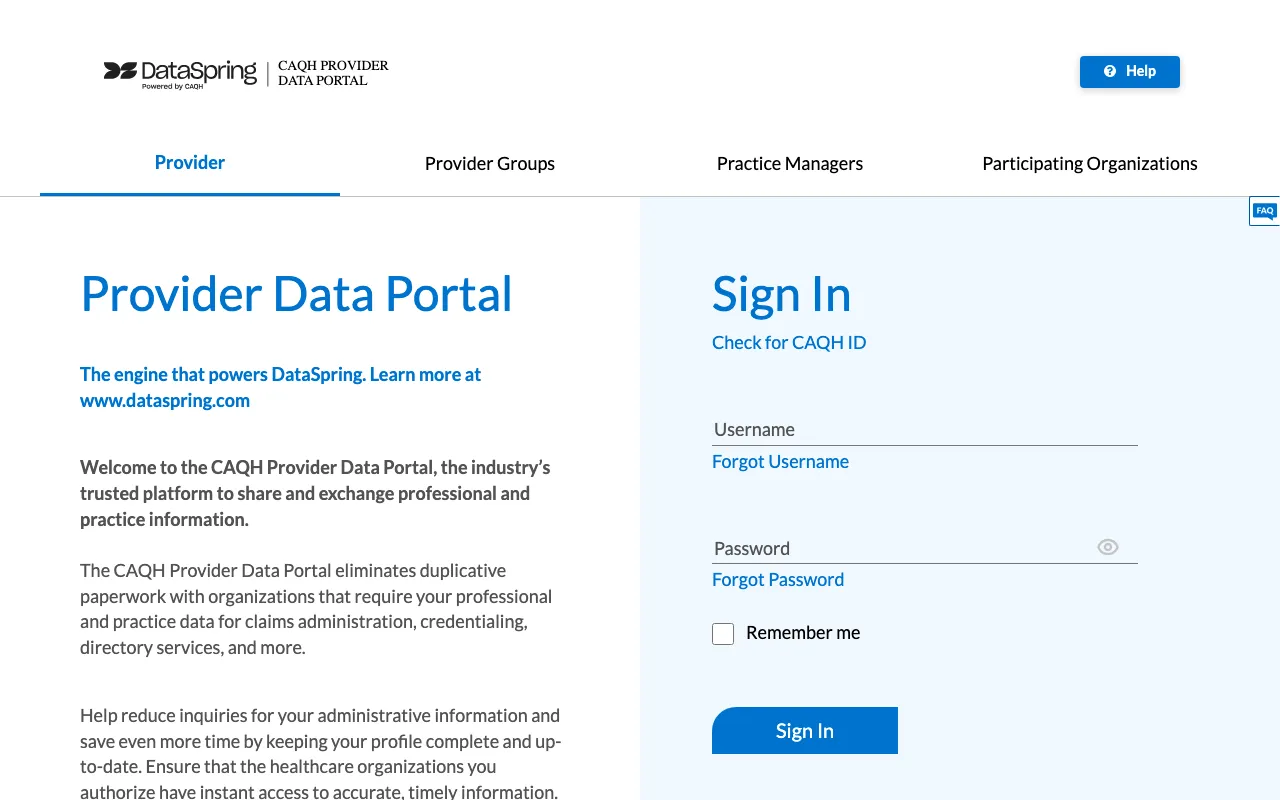
CAQH now does business as DataSpring. The DataSpring page for clinicians says your portal access, account, and profile stay the same, and that the platform costs clinicians nothing. The login is still the CAQH Provider Data Portal at proview.caqh.org.
The rule that matters most is in the DataSpring FAQ: providers must attest to their profiles "every 120 days (every 180 days for IL providers)." Illinois is the only exception named, so Oregon clinicians are on 120 days. You attest whether or not anything changed. Attesting means reviewing each section, replacing expired documents, and confirming the whole profile is true and complete.
Miss the window and the same FAQ says your status changes to Expired. DataSpring then follows up by email, and by phone if the email goes unanswered. The real cost is quieter: plans pull from this profile when they credential and recredential you, so an expired profile can hold up both until you attest again.
The quarterly email, if your plan uses it
Some plans use DataSpring to collect their provider information every quarter. If one of yours does, you will get an email each quarter asking you to log in and review the details that plan shows its members about you. The FAQ says providers who complete the attestation steps from that email "will, in fact, be re-attesting to their data every 90 days."
Two limits. Not every plan uses the service, and the email only arrives on behalf of plans that do. And if you skip the email, the 120-day attestation still applies. Treat the email as an early attestation, never as a reason to drop the 120-day reminder.
Plans are chasing this because federal law makes them. Since 2022, 42 U.S.C. 300gg-115 has required a plan to verify the information it publishes about its network providers at least once every 90 days and to update it within two business days of hearing from you. A companion section, 42 U.S.C. 300gg-139, puts a matching duty on you: send the plan your name, address, specialty, phone, and digital contact information when a network agreement starts or ends, when any of it materially changes, and when the plan asks.
The three-year recredentialing cycle
NCQA, the body that accredits most commercial health plans, says it plainly in its November 2024 explainer: "NCQA requires recredentialing every three years." Plans that hold NCQA accreditation run on that clock.
For Oregon's coordinated care organizations, the rule is OAR 410-141-3510. In the version effective January 1, 2026, a CCO must recredential its providers within three years. If you were credentialed on the first of a month, the three years run from that date; if on any other day, they run from the first of the following month. The rule also requires a check of the National Practitioner Data Bank each cycle and requires CCOs to accept the Oregon Practitioner Recredentialing Application.
That form, the OPRA, is the shorter sibling of the application you filed the first time. OHA's recredentialing application page lists the 2025 version as the one now mandated and gave credentialing organizations until September 14, 2026 to switch to it. The plan starts recredentialing, not you, but the plan's letter does not always arrive with much warning. Your approval letter has the date; add three years and put it on your own calendar.
OHP revalidation and reporting changes
If you enrolled with the Oregon Health Authority to bill OHP directly, there is a fourth clock. OHA's provider enrollment page says it rescreens every enrolled provider at least once every five years and asks for changes within 30 days. Each CCO credentials separately from OHA, so a CCO contract keeps its own three-year cycle.
When something changes
A new office, a new phone line, a new LLC and tax ID, a move to telehealth only: each is a material change under 300gg-139, and each one belongs in three places. Update the CAQH profile and attest. Send every plan written notice, using the form or portal its provider manual names. If you are enrolled with OHA, report it there within 30 days. A change of tax ID can mean more than an update, so ask each plan whether it needs new contract paperwork.
How to do it
- Log in to the CAQH Provider Data Portal and write down your profile status and the date you last attested.
- Add a calendar reminder for 120 days after that date, and a second one two weeks earlier so a busy week does not cost you the window.
- Before you attest, replace anything that has expired or will expire before the next attestation: your license, the face sheet of your liability policy, and a W-9 that matches the tax ID you bill under. Check that your work history has no unexplained gaps.
- Open the authorization section and confirm that every plan you contract with can see your profile.
- Attest. Note the new date on your calendar and start the 120 days over.
- When a quarterly email from DataSpring arrives, check that it is genuine, then complete it. The DataSpring FAQ explains what it asks for.
- Find the effective date on each plan's approval or last recredentialing letter, add three years, and add a reminder a few months before. Keep a copy of the 2025 OPRA on hand.
- If you bill OHP directly, note your revalidation date and report changes within 30 days through OHA provider enrollment.
- Keep a one-page log: each plan, its effective date, the last recredentialing date, the next one due, and who you spoke with.
This is business education, not legal advice. Your contracts and each plan's provider manual set the details, and they govern wherever they differ from anything here.
Further reading
- DataSpring: resources and FAQ. The attestation cycle, the Expired status, and the quarterly email, in the company's own words.
- OAR 410-141-3510. Oregon's credentialing rule for CCOs, including the three-year count and the data bank check.
- OHA: Oregon Practitioner Recredentialing Application. The current form and the date organizations had to adopt it.
- 42 U.S.C. 300gg-139. What federal law asks a provider to report to plans, and when.
- Oregon payer contacts and where each application starts. Where each plan's provider relations team lives, for the notices in step 7.
Sources
- “Resources and FAQ (CAQH Provider Data Portal).” DataSpring (formerly CAQH). 120-day attestation (180 for Illinois), Expired status and follow-up, quarterly email counts as re-attesting every 90 days, free for providers. https://www.dataspring.com/resources (accessed Nov 16, 2026).
- “For clinicians and office staff.” DataSpring (formerly CAQH). CAQH is now DataSpring; portal access and profile unchanged; no cost to clinicians. https://www.dataspring.com/clinicians (accessed Nov 16, 2026).
- “NCQA's Credentialing Standards Ensure Safety and Integrity of Practitioner Networks.” NCQA, Nov 19, 2024. NCQA requires recredentialing every three years. https://www.ncqa.org/blog/ncqas-credentialing-standards-ensure-safety-and-integrity-of-practitioner-networks/ (accessed Nov 16, 2026).
- “OAR 410-141-3510 (provider credentialing for CCOs and other managed care entities).” Oregon Health Authority (Oregon Administrative Rules). Version effective 2026-01-01 (DMAP 94-2025): recredentialing within three years, National Practitioner Data Bank review, OPCA and OPRA accepted. https://secure.sos.state.or.us/oard/view.action?ruleNumber=410-141-3510 (accessed Nov 16, 2026).
- “Oregon Practitioner Recredentialing Application (OPRA).” Oregon Health Authority, Advisory Committee on Physician Credentialing Information. 2025 version mandated; organizations had until 2026-09-14 to comply. https://www.oregon.gov/oha/HPA/OHIT-ACPCI/Pages/State-Rec-App.aspx (accessed Nov 16, 2026).
- “Oregon Health Plan (OHP) Provider Enrollment.” Oregon Health Authority. Changes within 30 days; revalidation at least every five years; CCO credentialing handled by each CCO. https://www.oregon.gov/oha/HSD/OHP/Pages/Provider-Enroll.aspx (accessed Nov 16, 2026).
- “42 U.S.C. 300gg-115 (plan duty to verify and update provider information).” Legal Information Institute, Cornell Law School. Verify at least every 90 days; update within two business days of receiving provider information. https://www.law.cornell.edu/uscode/text/42/300gg-115 (accessed Nov 16, 2026).
- “42 U.S.C. 300gg-139 (provider duty to submit information to plans).” Legal Information Institute, Cornell Law School. Submit at start or end of a network agreement, on material changes, and on request; in place by January 1, 2022. https://www.law.cornell.edu/uscode/text/42/300gg-139 (accessed Nov 16, 2026).
Study guide
Four clocks after you are in-network
| Clock | How often (as of November 2026) |
|---|---|
| Quarterly confirmation email | About every 90 days, only for plans that use DataSpring's service |
| CAQH attestation | Every 120 days (180 only in Illinois) |
| Recredentialing | At least every three years (NCQA; OAR 410-141-3510 for CCOs) |
| OHP revalidation | At least every five years (OHA) |
The 120-day attestation
- CAQH is now DataSpring; the portal, login, and profile carry over, and it is free for clinicians
- Attest every 120 days whether or not anything changed
- Miss it and the status becomes Expired; DataSpring follows up by email, then phone
- Plans pull from the profile to credential and recredential, so an expired profile can hold up both
The quarterly email
- Only arrives for plans that use DataSpring to collect provider information
- Completing it counts as re-attesting, so those providers attest about every 90 days
- Skip it and the 120-day attestation still applies
- Federal law: a plan verifies what it publishes about you at least every 90 days and updates it within two business days of hearing from you (42 U.S.C. 300gg-115)
- Your side: report your information when a network agreement starts or ends, when it materially changes, and when asked (42 U.S.C. 300gg-139)
Recredentialing
- NCQA requires recredentialing every three years
- OAR 410-141-3510 (effective January 1, 2026): CCOs recredential within three years, counted from the credentialing date if it fell on the 1st, otherwise from the 1st of the next month; each cycle includes a National Practitioner Data Bank check
- The form is the OPRA; the 2025 version is mandated, with a switch-over date of September 14, 2026
- Calendar it yourself from the date on your approval letter
OHP and changes
- OHA rescreens enrolled providers at least every five years and wants changes within 30 days
- CCOs credential separately from OHA
- A change goes to three places: the CAQH profile (then attest), each plan in writing, and OHA if enrolled
- A new tax ID: ask each plan whether it needs new contract paperwork
Key terms
- Attestation: your confirmation that the CAQH profile is true and complete
- Expired: the profile status after a missed attestation
- Recredentialing: the plan's periodic recheck of your file
- OPRA: the Oregon Practitioner Recredentialing Application
- Revalidation: OHA's periodic rescreening of enrolled OHP providers
Check what you learned
10 questions from this lesson. Answers are checked as you go; nothing is recorded.
1 / 10
How often must an Oregon clinician attest to a CAQH Provider Data Portal profile?
Hint
Look at the section on the 120-day attestation.
DataSpring's FAQ sets attestation at every 120 days. The 180-day cycle applies only to Illinois providers.
2 / 10
What happens to a CAQH profile if you do not attest within the required time?
Hint
The DataSpring FAQ names the status.
The FAQ says the status changes to Expired, and DataSpring follows up by email and then by phone.
3 / 10
What does completing DataSpring's quarterly confirmation email do?
Hint
See the section on the quarterly email.
DataSpring says providers who complete the attestation steps from the quarterly email are re-attesting every 90 days.
4 / 10
None of your plans use DataSpring's quarterly email service. Which attestation clock applies to you?
Hint
The email is an early attestation, not a replacement.
The quarterly email depends on a plan using the service. Without it, the 120-day attestation still applies.
5 / 10
How often does NCQA require recredentialing?
Hint
NCQA's November 2024 explainer says it in one sentence.
NCQA says it requires recredentialing every three years.
6 / 10
Under OAR 410-141-3510, what must every CCO credentialing and recredentialing cycle include?
Hint
See the three-year recredentialing section.
The rule requires review of any information in the National Practitioner Data Bank, alongside the three-year recredentialing count.
7 / 10
You were credentialed with a CCO on the 15th of a month. From when does the three-year recredentialing window run under OAR 410-141-3510?
Hint
The rule treats the first of a month differently from any other day.
If you were credentialed on a day other than the first, the three years run from the first of the following month.
8 / 10
How often does OHA rescreen providers enrolled to bill OHP, and how soon does it want changes reported?
Hint
See the OHP revalidation section.
OHA's provider enrollment page says revalidation happens at least every five years and changes should be submitted within 30 days.
9 / 10
Under 42 U.S.C. 300gg-115, how often must a plan verify the information it publishes about its network providers?
Hint
It is the federal reason plans send quarterly emails.
The statute requires verification at least once every 90 days and an update within two business days of hearing from the provider.
10 / 10
Your practice moves to a new office. Where does the change belong?
Hint
The lesson names three places.
A material change goes to the CAQH profile, to every plan in writing, and to OHA within 30 days if you bill OHP directly.
Worth another look


